Table of Contents
⚡ KEY TAKEAWAYS: Rann Utsav 2026-27
- Rann Utsav 2026-27 runs at the Tent City in Dhordo, Kutch (Kachchh), from 1 November 2026 to 7 March 2027 (official site, checked 28 October 2026).
- Tent City packages start at ₹6,300 per person a night, sharing, before taxes. Full-moon periods, Diwali week, and Christmas week cost more.
- Every White Rann visitor needs an entry permit, from Gujarat's online permit portal or the Bhirandiyara checkpost. Carry original photo ID.
- The best full-moon nights on the salt are 24 November, 23 December, 22 January, and 20 February (US Naval Observatory times, converted to IST).
- Bhuj is the gateway: Dhordo is about 85 km away, around 1 hour 45 minutes by road, by the operator's estimate.
| Key term | Meaning |
|---|---|
| Rann | A seasonal salt marsh; in Kutch, flats that flood in the monsoon and dry white in winter. |
| White Rann | The white salt crust of the Great Rann of Kutch near Dhordo, visited during Rann Utsav. |
| Tent City | The operator-run tented camp at Dhordo that hosts Rann Utsav stays from November to March. |
| Bhunga | A round, mud-walled house of Kutch, also used as guest lodging in Dhordo. |
| White Rann permit | The entry permit every visitor needs for the White Rann border area. |
| Bhirandiyara checkpost | The permit counter on the road from Bhuj to Dhordo. |
| Full-moon period | The three dates around each full moon when Tent City rates are higher. |
| Rogan | An oil-based paint drawn onto cloth, kept by the Khatri family of Nirona. |
| Kachchh | The official spelling of Kutch, the Gujarat district that holds the Great Rann. |
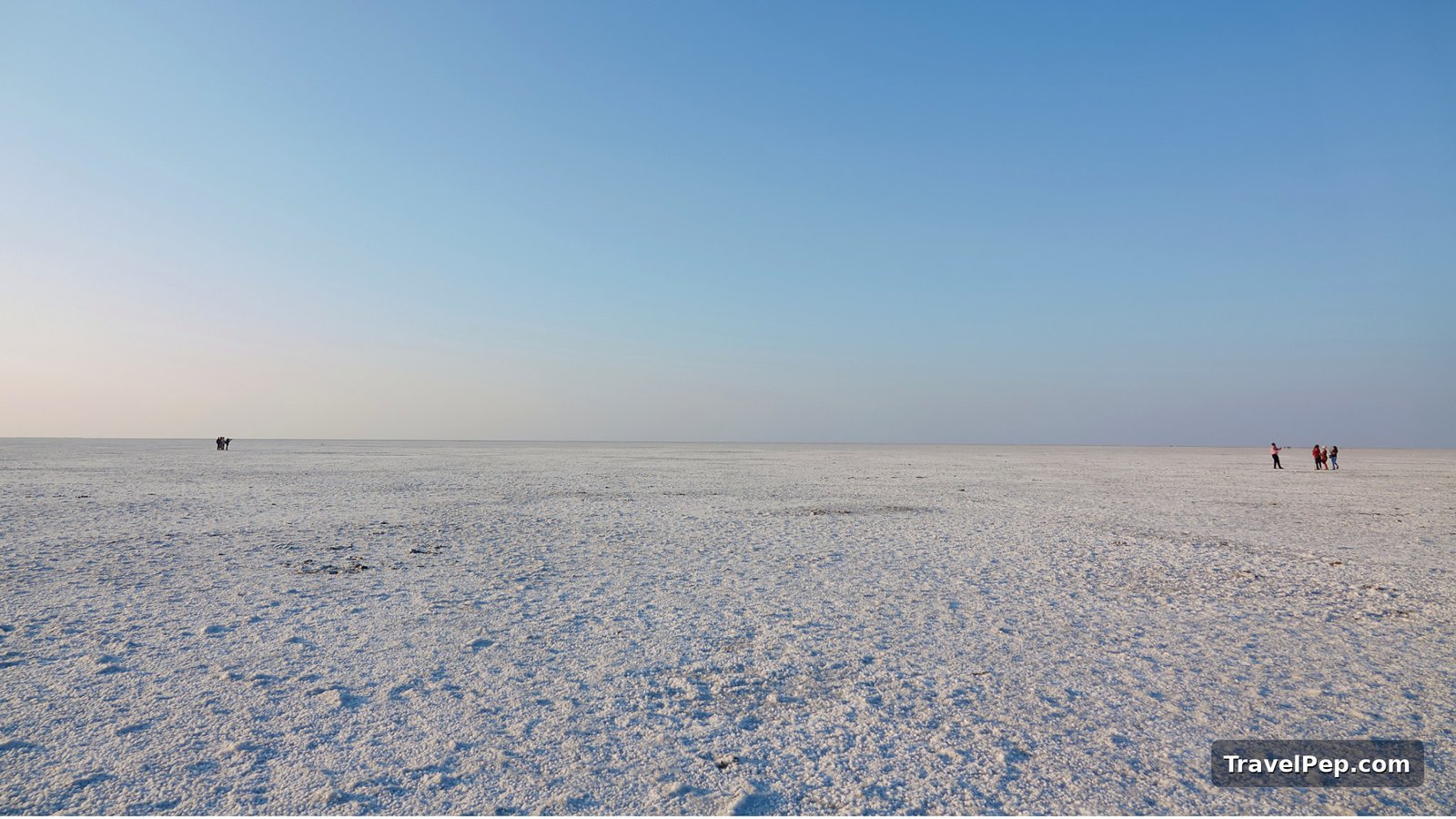
Each monsoon floods the salt flats north of Bhuj, and from October, by the Tent City operator’s own account, the water dries into the white crust that Rann Utsav is built around. In a wet year the water lingers, which is the first thing to know about a festival whose calendar is set by evaporation and by the moon.
Information checked on 28 October 2026.
Why the Rann Sets the Calendar at Dhordo
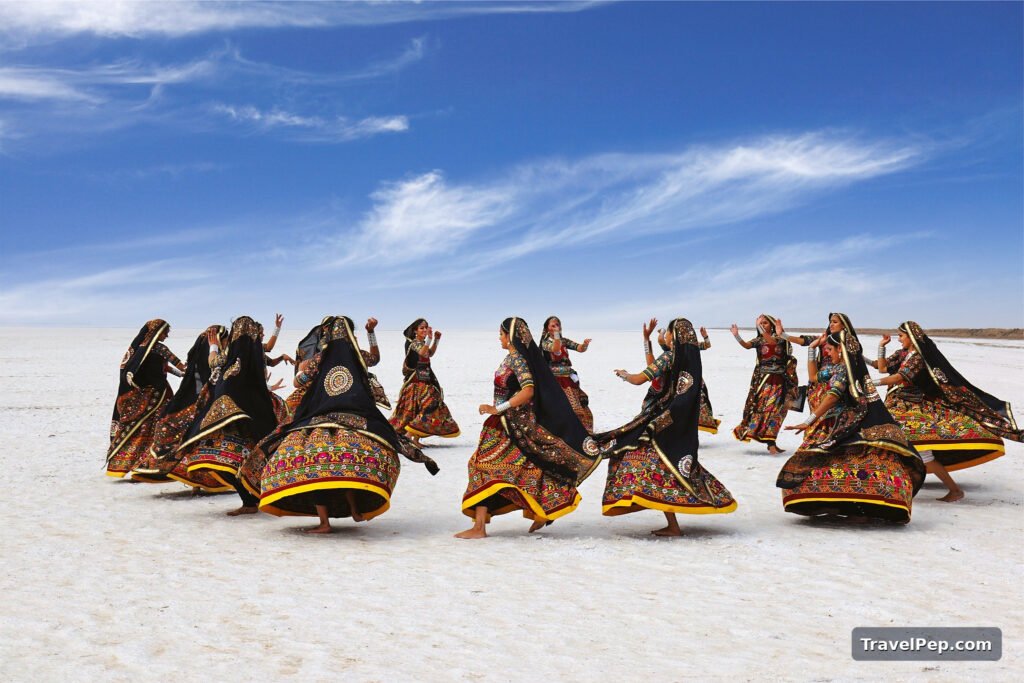
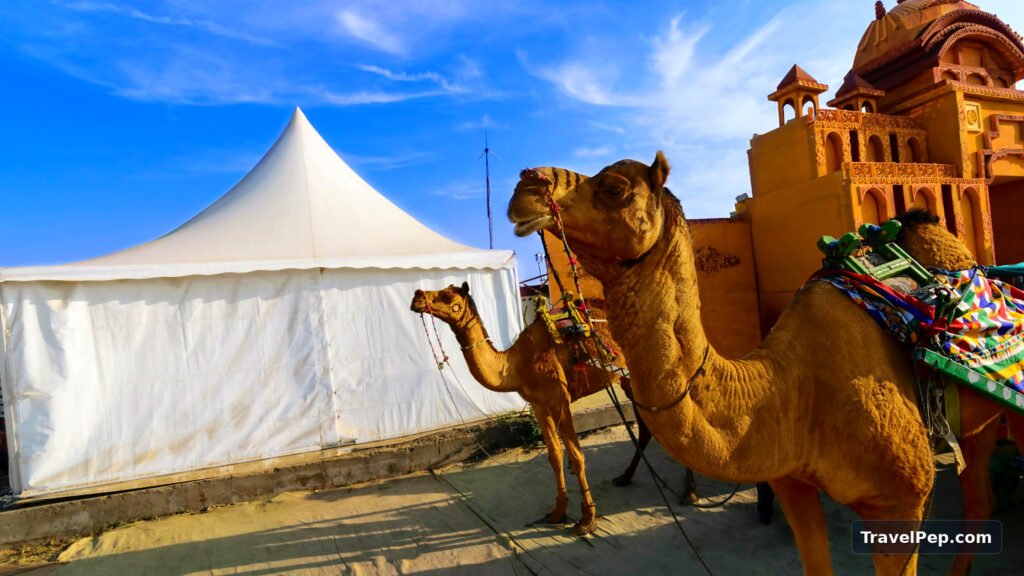
Rann Utsav 2026-27, like the seasons before it, is two things under one name. One is a winter season of tents at Dhordo, on the edge of the Great Rann of Kutch (Kachchh in official records), run by an operator that Gujarat Tourism names on its own festival page. The other is Dhordo itself, a village of the Banni grasslands that Gujarat Tourism describes as known for its mud craft and for Mutwa embroidery, the needlework of the Mutwa community.
In October 2023, at a ceremony in Samarkand, Uzbekistan, the Ministry of Tourism’s director general, Manisha Saxena, accepted UN Tourism’s Best Tourism Village recognition for Dhordo, chosen from about 260 applications from 60 countries, according to the ministry’s rural tourism newsletter. The same newsletter describes a village where bhungas (round, mud-walled houses) serve both as family homes and as lodgings for visitors. The award recognised the village, not the tents beside it, and the distinction matters when you decide where your money goes.
The salt does not keep to anyone’s booking calendar. The Rann floods each monsoon and whitens only as the water dries. The official Tent City site has carried a notice that heavy rain delayed the white crust in a recent season.
Within the season, the moon sorts the nights. Full-moon periods carry the highest rates and, the operator says, the highest demand; dark-moon nights trade the glow for a sky of stars. Your dates and your choice of bed decide most of what a trip here costs, though weather and access on the day still shape what you see.
Rann Utsav 2026-27 Dates and the Best Nights to Go
The Tent City season runs from 1 November 2026 to 7 March 2027, according to the official Rann Utsav website (checked 28 October 2026). These are the Tent City’s operating dates. When checked, Gujarat Tourism’s festival page had not yet posted 2026-27 programme dates; last season it listed a shorter festival window, 23 November 2025 to 20 February 2026, inside a Tent City season that ran until 4 March 2026.
| Month | Higher-rate period (as listed by the operator) | Full moon peaks (IST) | Best planned night for moonlight | Dark-moon date |
|---|---|---|---|---|
| November 2026 | 23 to 25 November | 24 November, 8:23 pm | 24 November | 9 November |
| December 2026 | 22 to 24 December | 24 December, 6:58 am | 23 December | 8 December |
| January 2027 | 21 to 23 January | 22 January, 5:47 pm | 22 January | 7 January |
| February 2027 | 19 to 21 February | 21 February, 4:53 am | 20 February | 6 February |
Periods and dark-moon dates: official Rann Utsav special dates page. Peak times: US Naval Observatory, converted from UTC to IST. Both checked 28 October 2026. The operator’s page lists these periods but still carries “dates will be announced soon” notes beneath them, so confirm your dates on the live booking calendar. Clear skies, not the calendar, decide the view.
The operator says its peak surcharge applies from one day before the full-moon dates, so the night before a listed period may also cost more; the booking calendar shows the price for your night. Where the moon peaks before dawn, as on 24 December and 21 February, the night before is the one to be out on the salt. Diwali week (8 to 14 November 2026) and Christmas week (18 December 2026 to 2 January 2027, which covers New Year) also carry higher rates, and the operator advises booking these weeks, full-moon nights, and weekends early.
The light follows a tight timetable. Packages run the sunset visit from 5 pm to 7:30 pm and, from the second night, a sunrise visit that leaves at 6 am. In Bhuj, the season’s earliest sunset falls at about 6:05 pm on 28 November. Its latest sunrise comes at about 7:33 am on 14 January, so in midwinter the sunrise trip spends most of its hour in the blue light before dawn.
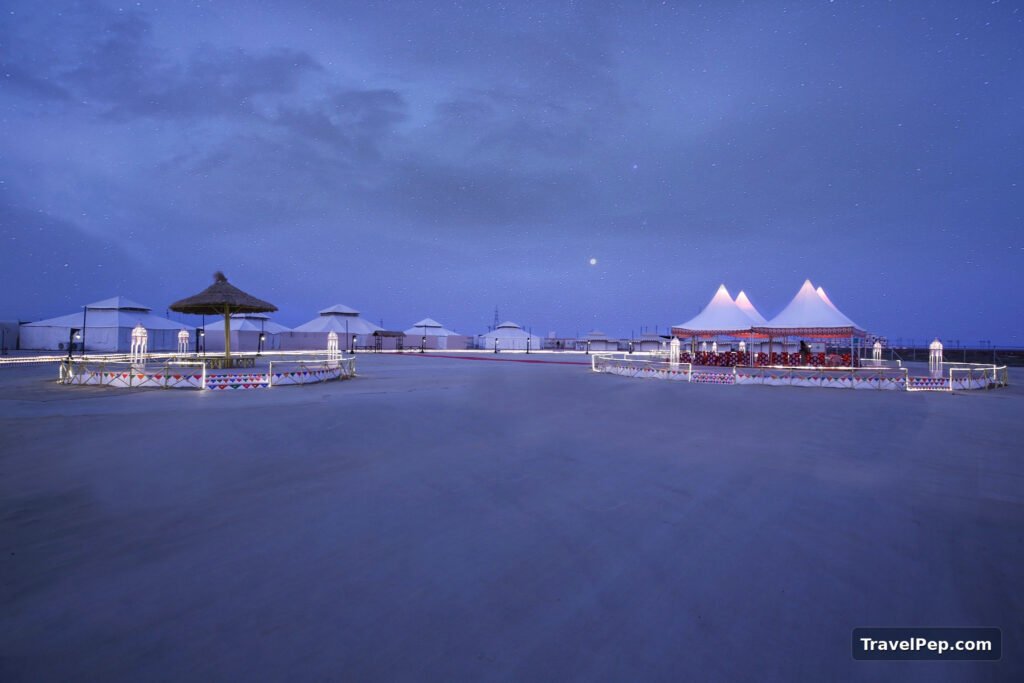
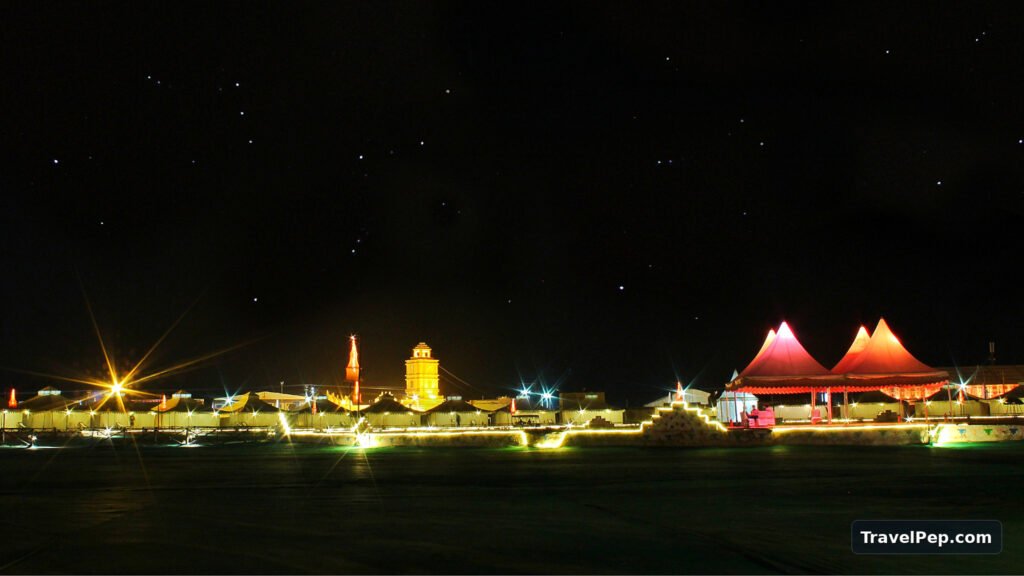
A full moon rises near sunset, so full-moon evenings pair the last colour in the west with a white disc climbing in the east. Gujarat Tourism’s event listings for recent seasons have included a watchtower at the White Rann; ask on arrival whether it is open.
Leave the drone at home. Under the Drone Rules, 2021, drones may fly in a red zone only with central government permission, and unauthorised entry is an offence (Ministry of Civil Aviation reply in the Rajya Sabha, 5 August 2024). The Kutch district administration places the White Rann in the international border area. Check the Digital Sky airspace map to see restricted zones; the map does not grant permission, so do not fly a drone at the White Rann without written permission from the authorities.
Tent City Tents, Prices, and What a Package Includes
The Tent City publishes its rates per person, for two people sharing, on its official packages page. These are the regular-date rates, before taxes (checked 28 October 2026).
| Tent category | 1 night | 2 nights | 3 nights |
|---|---|---|---|
| Non-AC Swiss Cottage | ₹6,300 | ₹12,600 | ₹18,900 |
| Deluxe AC Swiss Cottage | ₹8,300 | ₹16,600 | ₹24,900 |
| Premium Tent | ₹9,300 | ₹18,600 | ₹27,900 |
| Super Premium Tent | ₹10,300 | ₹20,600 | ₹30,900 |
| Rajwadi Suite (per suite, 2 guests, all dates) | ₹35,000 | ₹70,000 | ₹1,05,000 |
| Darbari Suite (per suite, 4 guests, all dates) | ₹70,000 | ₹1,40,000 | ₹2,10,000 |
On dates the official rate calendar marks as higher bands, each person pays ₹2,000, ₹3,500, or ₹4,500 more for one, two, or three nights in the middle band, and ₹4,000, ₹6,000, or ₹8,000 more in the top band. Children under 6 stay free. A third person over 6 pays the extra-mattress rate, and single occupancy is charged at 75% of the double-occupancy cost. Supplements are per person; suite prices are per suite. The booking page shows the final total, with taxes, before you pay.
Every package covers the tent, five meal sittings a day from morning tea to dinner, and the evening cultural programme. The official itineraries add shared coaches from Bhuj Railway Station and Bhuj Airport at fixed times, but the operator says transfers and sightseeing depend on the package, so read yours before paying. One night buys the sunset visit to the salt, then the Swaminarayan Temple and the Kutch Museum in Bhuj on the way out; the museum closes on Wednesdays. Two nights add the sunrise visit, Kalo Dungar, and Gandhi nu Gaam.
Three nights add Dholavira, about 105 km and two hours away by the operator’s estimate. Check-in is at 12:30 pm and check-out at 9:30 am. Cancel 30 or more days ahead for a 90% refund, or 15 to 29 days ahead for 60%; after that, nothing comes back. Changing your check-in date costs 10% of the booking, so compare that figure if a reseller quotes different terms.
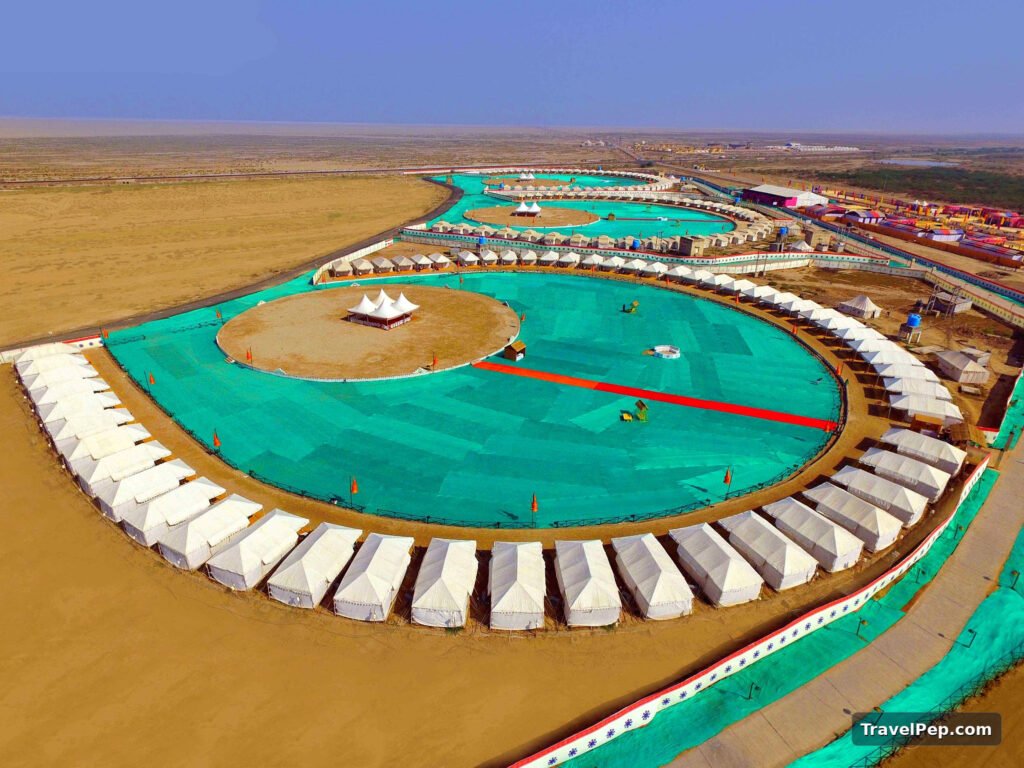
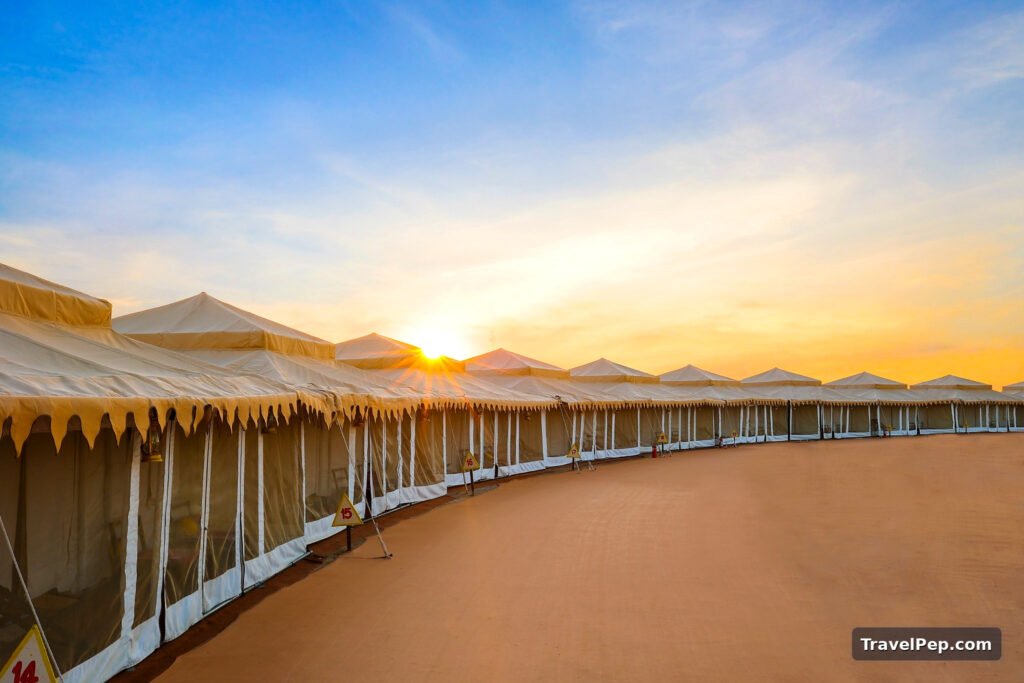
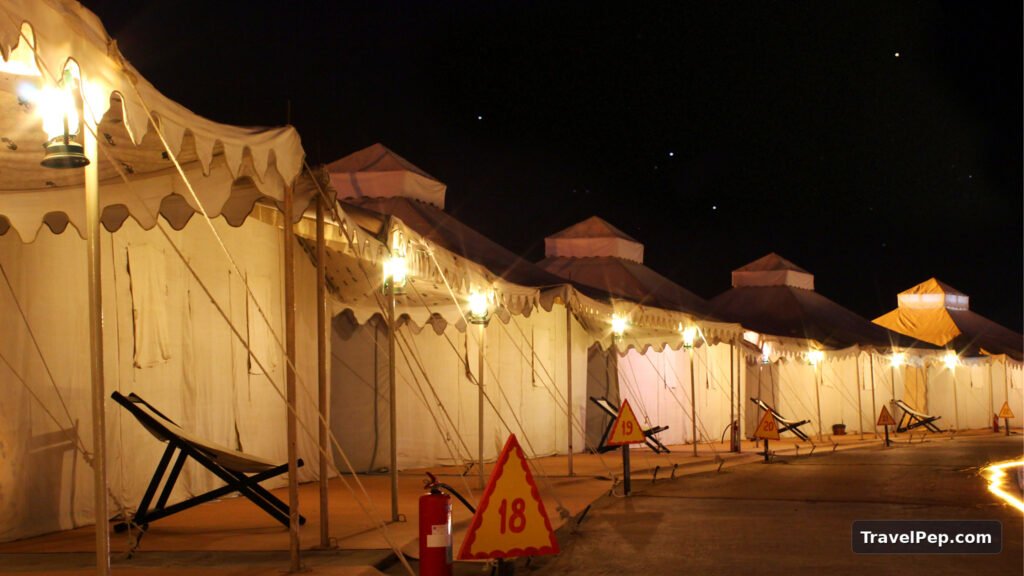
Book only through the official site. Gujarat Tourism’s Rann Utsav page names rannutsav.net as the official website, and the toll-free number on that site is 1800 270 2700. Several websites with similar names call themselves official and quote different season dates and phone numbers (checked 28 October 2026). The official site says payments for its bookings are processed by Eyak Ventures Pvt. Ltd., the owner of its booking partner, Evoke Experiences, so check that name before you pay.
Is the Tent City worth the price? It buys proximity, meals, and logistics, not access: anyone with a permit can stand on the same salt. From a hotel in Bhuj, about 85 km away, the sunset visit ends with a drive of nearly two hours in the dark. The 6 am sunrise departure means leaving Bhuj at about 4:15 am. Families, older travellers, and first-timers who want one booking to cover everything are likely to get the most from the package.
Travellers with their own car and a permit, or a taste for village life, can stay in Dhordo instead. Gujarat Tourism keeps a list of registered homestays; check that a listing is in Dhordo itself before you book. A UN Tourism article counted 63 registered homestay and bhunga units in the area in 2025.
Access needs: the official pages give no step-free or wheelchair information for the tents, coaches, toilets, or the walk onto the salt. Call the operator on 1800 270 2700 before booking and ask about each.
Finding the calm: Dhordo village, beside the Tent City, where the mud-walled houses, the lippan kaam (mud-and-mirror relief work) on their walls, and the needlework of the Mutwa community slow the pace after the sunset visit. Ask your host or the Tent City desk which households welcome visitors, and ask before photographing anyone.
The White Rann Permit at Bhirandiyara
Every visitor to the White Rann needs an entry permit, because the salt flats lie in the international border area; the Kutch district administration’s permit system also covers Kalo Dungar. Gujarat Tourism’s Rann Utsav page links to the state’s online permit portal. The alternative is the permit counter at the Bhirandiyara checkpost, on the road from Bhuj to Dhordo.
The permit has cost ₹100 for each person over 12 and ₹50 for children aged 6 to 12 in recent seasons, and it is free for children up to 5. The online portal is for Indian nationals; foreign nationals apply at Bhirandiyara with copies of their passport and visa. On 28 October 2026 the portal would not open. If it fails for you too, use the Bhirandiyara counter, and pass it well before mid-afternoon.
Carry the original government photo ID you used to apply, and keep it at hand for the checks near Dhordo. The official Tent City package pages do not say whether the permit is included, so ask before you pay.
Getting there and hours: Dhordo is about 85 km from Bhuj, a drive of about 1 hour 45 minutes by the operator’s estimate. Allow at least 2 hours with the permit stop. Package visits run: sunset from 5 pm to 7:30 pm, sunrise from 6 am to 7:30 am (checked 28 October 2026).
Transport safety: The Tent City’s free coaches leave Bhuj at 8:15 am, 10 am, 1:30 pm, 3:30 pm, and 5:30 pm only (official schedule, checked 28 October 2026). No free transfer runs after the last one, so time your train or flight to meet a coach. If you drive yourself, fill the tank in Bhuj and plan the route back before the sunset visit. The return is about 85 km in the dark.
Getting to Dhordo from Bhuj
Bhuj is the gateway, and the last stretch to Dhordo is by road. Gujarat Tourism places Bhuj Airport 4 km from the city. Bhuj Railway Station is the other pickup point for the Tent City coaches, and the official site links to the Gujarat State Road Transport Corporation for bus bookings into Kutch. Check flight and train times for your dates with the airlines and Indian Railways.
- Tent City guests: take the free shared coach from the airport or the station at a fixed time, or pay for a private transfer arranged by the operator.
- Day visitors: hire a taxi in Bhuj or drive yourself, with the permit arranged online or at Bhirandiyara on the way.
- Return to Bhuj: the package coaches leave Dhordo at 4:30 am and 9:30 am only; book a train or flight that fits one of them.
Weather, Cold Nights, and What to Pack
Winter days in Kutch are warm and its nights are cold. On 21 and 22 January 2026, the India Meteorological Department recorded Bhuj at 30°C by day and 15.4°C by night, and gave those readings as 2.2°C and 3.5°C above normal. IMD’s normals for those dates are therefore about 28°C and 12°C.
Pack for both ends of the day:
- a warm jacket, a cap, and gloves for children and older travellers;
- layers you can remove by mid-morning;
- sunglasses, a hat, and sunscreen, because the white surface reflects sunlight back at you;
- closed shoes for the crusted salt;
- the original photo ID you used for the permit.
⚠️ Cold nights: IMD recorded a minimum of 15.4°C in Bhuj on 22 January 2026, and its normal for that date is about 12°C. Check the forecast shortly before you travel. If you have a heart or lung condition, or are travelling with an infant, ask your doctor how to manage cold early starts.
⚠️ Late-forming salt: after a heavy monsoon, water can linger on the Rann into the season, as the official Tent City site has warned in a recent year; ask the operator about conditions before you travel early in the season.
⚠️ Crowd peaks: Christmas week (18 December 2026 to 2 January 2027) and the full-moon periods carry the top rates and, the operator says, the highest demand (official Rann Utsav special dates page).
⚠️ Border area: the White Rann lies in the international border area, so carry your permit and original ID and follow the instructions of the security staff (Kutch district administration).
Kutchi Food at the Festival and in Bhuj
At the Tent City, every meal is part of the package and served at set hours: morning tea from 6 am, breakfast from 7:30 am, lunch from 12:30 pm, hi-tea at 4 pm, and dinner from 7:30 pm. The operator’s FAQ says the menu is vegetarian throughout, mixing Kutchi and other Indian dishes, with continental and Jain options. Mention any other dietary need when you book, and reconfirm it before you arrive.
In Bhuj, look for dabeli, a soft bun filled with spiced potato. The Kutch district administration traces the dish to Mandvi, on the Kutch coast, and says the dabeli masala made there is still held to be the most authentic.
Rogan Art from Nirona: What to Buy and How
Rogan (from the Persian for “oil-based”, as the People’s Archive of Rural India explains it) is a thick paint drawn onto cloth in fine lines. In Nirona, a village that the Khatri family’s own site places about 40 km from Bhuj, the craft is kept by the Khatri family, who trace it back eight generations. Its best-known practitioner, Abdul Gafur Khatri, received the Padma Shri in 2019, and, Village Square reports, the family runs demonstrations and workshops for visitors. Nirona’s other workshops make leatherwork and lacquerwork.
Buy rogan where it is made. Ask who painted the piece in front of you, and expect a price that pays for hand painting, not for printed cloth. Ask before photographing anyone at work, since the workshops are family homes. The same care applies across Kutch’s craft stalls: never buy anything made from protected species, such as corals, shells, or feathers covered by the Wildlife Protection Act, 1972.
Beyond Dhordo: Kalo Dungar, Dholavira, and Bhujodi
- Kalo Dungar: the highest point in Kutch at 462 m, about 90 km north of Bhuj, with views over the Great Rann (Gujarat Tourism). It sits in the permit zone, and the two-night Tent City package includes it.
- Dholavira: a Harappan city inscribed as a UNESCO World Heritage Site in 2021 (Ministry of Tourism). The three-night package reaches it by the Road to Heaven, about 105 km and two hours from the Tent City; check Friday opening before you go, as sources differ on whether the museum or the whole site closes that day.
- Bhujodi: a weaving village near Bhuj, where you can watch looms at work before your train or flight home.
Rann Utsav Budget for 2026-27
The estimates below cover a two-night stay per person, from Bhuj and back, and leave out travel to Bhuj. Tent City figures are the official rates before taxes, checked 28 October 2026.
| Vibe | What it covers | Per person, 2 nights |
|---|---|---|
| Scrappy | A room in Bhuj, a taxi or your own car, food, and the permit | Total not yet calculated: Bhuj room and taxi rates are unverified for this season; the permit costs ₹100 per adult |
| Comfort | Deluxe AC Swiss Cottage at the Tent City, all meals, coach transfers, and package sightseeing | ₹16,600 on regular dates to ₹22,600 on top-band dates |
| Luxury | Super Premium Tent, or the Rajwadi Suite for two | ₹20,600 to ₹26,600 in a Super Premium Tent; ₹35,000 each in the Rajwadi Suite |
If you book a Dhordo homestay instead, ask the host what the price includes: meals, the permit, and transport to the salt are the costs most likely to differ.
Safety and Emergency Numbers in Kutch
Dial 112 for police, fire, or ambulance anywhere in India; the Ministry of Home Affairs runs it as the national emergency number (checked 28 October 2026). On the salt, stay within the area the security staff open to visitors, keep your permit and ID with you, and agree a meeting point with children before dark, when one figure on the flat white ground looks much like the next.
Quick Insights: Rann Utsav 2026-27 at a Glance
- For stars instead of moonlight, choose the dark-moon nights: 9 November, 8 December, 7 January, and 6 February.
- The package sunrise visit leaves at 6 am. In mid-January, Bhuj’s sunrise comes at about 7:33 am, so dress for the dark hour before dawn.
- Children under 6 stay free at the Tent City, and single occupancy costs 75% of the double-occupancy rate.
- Dhordo was named a UN Tourism Best Tourism Village in 2023, and Gujarat Tourism lists registered homestays for visitors who prefer the village to the tents.
- Do not fly a drone at the White Rann without written permission; red zones under the Drone Rules, 2021 need central government approval.
- Rogan painting comes from the Khatri family of Nirona, about 40 km from Bhuj, where workshops sell directly to visitors.
- In an emergency anywhere in Kutch, dial 112 for police, fire, or ambulance.
Rann Utsav 2026-27: Frequently Asked Questions
When is Rann Utsav 2026-27?
The Tent City at Dhordo runs from 1 November 2026 to 7 March 2027 (official site, checked 28 October 2026). Gujarat Tourism had not yet published its 2026-27 festival programme dates when checked.
Do I need a permit to visit the White Rann?
Yes. Every visitor needs an entry permit, available on Gujarat’s online permit portal or at the Bhirandiyara checkpost on the Bhuj to Dhordo road. The online permit is for Indian nationals; foreign nationals apply at the checkpost with passport and visa copies.
Can I visit the White Rann without staying at the Tent City?
Yes. With a permit and your own transport, you can visit from Bhuj, about 85 km away, or stay at a registered homestay in Dhordo. Allow for a drive of nearly two hours each way, much of it in the dark after sunset.
Is the Tent City worth the price?
It suits travellers who want meals, transfers, sightseeing, and a bed near the salt in one booking, especially families and older travellers. Independent travellers with a car and a permit can see the same salt for less from Bhuj or a Dhordo homestay.
What should I pack for Rann Utsav nights?
Pack a warm jacket, a cap, and gloves, because early mornings are cold: IMD’s normal minimum for Bhuj on 22 January is about 12°C. Add sunglasses and sunscreen for the reflected daytime light, closed shoes, and your original photo ID.