Table of Contents
⚡ KEY TAKEAWAYS: Historical Places in India
- Historical places in India in this guide: 15 landmarks, 10 inside UNESCO World Heritage properties, with fees checked on 7 November 2026.
- The Taj Mahal costs ₹50 for Indians and ₹1,100 for foreign visitors, plus an optional ₹200 for the mausoleum, and closes on Fridays.
- ASI tickets bought online cost ₹5 less for Indians and ₹50 less for foreign visitors; children under 15 enter free.
- Ajanta and the Victoria Memorial galleries close on Mondays, so check closing days before planning a circuit.
- Dial 112 for emergencies anywhere in India; the Ministry of Tourism helpline is 1800-11-1363.
| Key term | Meaning |
|---|---|
| ASI | Archaeological Survey of India, which runs most national monuments and sets their fees |
| World Heritage property | A site inscribed on UNESCO’s World Heritage List |
| Tentative List | A country’s list of sites it may nominate to UNESCO |
| Hill Forts of Rajasthan | Six forts, including Amer and Kumbhalgarh, inscribed together in 2013 |
| Jharokha | A projecting, screened window, as on the Hawa Mahal |
| Gopuram | The towered gateway of a South Indian temple |
| Pietra dura | Coloured stone inlaid into marble, as on the Taj Mahal |
| Chorten | A Buddhist stupa, as at Rabdentse |
| SAARC and BIMSTEC rate | The fee for nationals of South Asian and Bay of Bengal neighbours |
| Kala Pani | “Black water”, the name for transportation to the Andaman penal colony |
Mumtaz Mahal died in childbirth at Burhanpur in 1631, and by 1648 Shah Jahan had raised her marble mausoleum beside the Yamuna. Nearly four centuries later, visitors still reach it through the red sandstone gateway that frames the tomb in its arch.
The historical places in India gathered here run from a 12th-century victory tower in Delhi to a colonial prison in the Bay of Bengal.
Ten of the 15 sit inside UNESCO World Heritage properties, several as parts of larger inscribed areas such as the Hill Forts of Rajasthan or the Group of Monuments at Hampi. The Cellular Jail is on India’s Tentative List, not the World Heritage List, and the other four are run by national, state or monastic bodies. The list spans five regions so that any circuit has at least one site; each entry gives the entry fee as listed on 7 November 2026, how to get there, one detail worth looking for, and a quiet place to rest nearby.
Information checked on 7 November 2026.
Entry fees and closing days at a glance
Fees for Archaeological Survey of India (ASI) sites are the cash rates; tickets bought online are ₹5 cheaper for Indians and ₹50 cheaper for foreign visitors, as listed on the ASI’s monument pages. Children under 15 enter ASI sites free. SAARC and BIMSTEC nationals pay the Indian rate at most ASI sites, though the Taj Mahal charges them ₹540 and Agra Fort ₹90. The last column shows how firm each fee is; the Agra Fort entry below explains its Friday and same-day Taj rates.
| Site | Indian (₹) | Foreign (₹) | Closed | Fee status |
|---|---|---|---|---|
| Taj Mahal | 50 (+200 optional mausoleum) | 1,100 (+200) | Friday | Official (ASI) |
| Agra Fort | 50 | 650 | None listed | Official pages disagree |
| Qutub Minar | 40 | 600 | None listed | Official (ASI) |
| Amer Fort | 200 | 1,000 | Check locally | Press report, Jan 2026 |
| Hawa Mahal | 100 | 600 | Check locally | Press report, Jan 2026 |
| Khajuraho (Western Group) | 40 | 600 | Check locally | ASI category rate, unconfirmed |
| Ajanta Caves | 40 | 600 | Monday | Official (ASI) |
| Konark Sun Temple | 40 | 600 | None listed | Official (ASI) |
| Virupaksha Temple, Hampi | Temple fee | Temple fee | Open daily | Set by the temple |
| Kumbhalgarh Fort | Not confirmed | Not confirmed | Check locally | Not confirmed |
| Gateway of India | Free | Free | Open space | Public space |
| Victoria Memorial | 50 | 500 | Galleries Monday | Official |
| Basgo Monastery | Small fee | Small fee | Check locally | Not confirmed |
| Rabdentse Ruins | No fee found | No fee found | Check locally | Not confirmed |
| Cellular Jail | 30 | 100 | Check locally | Official (Andaman Tourism) |
The northern capitals
Agra, Delhi and Jaipur form India’s most travelled heritage triangle, and its five sites cover four centuries of Sultanate, Mughal and Rajput building in sandstone and marble.
1. Taj Mahal, Agra

UNESCO dates the building to 1632 to 1648 and records it as a tomb Shah Jahan built for Mumtaz Mahal, in white Makrana marble quarried in Rajasthan. The site opens 30 minutes before sunrise, and the first hour after opening is the coolest time for the walk from the gateway to the plinth.
Shoulders and knees should be covered. Agra’s marble inlay workshops sell pietra dura in the tradition of the tomb’s own floral panels; ask to see the stone set into the marble rather than painted on. Petha, the city’s candied ash-gourd sweet, is sold in shops across Agra.
- Entry: ₹50 Indian, ₹540 SAARC and BIMSTEC, ₹1,100 foreign; the main mausoleum costs ₹200 more and is optional (official Taj Mahal site). Closed on Fridays.
- Getting there: Agra Cantt is the main railway station; the Taj has an east and a west gate, both reached by electric vehicles from the parking areas.
- Finding the calm: Mehtab Bagh, the Mughal garden across the Yamuna, faces the tomb from the north bank and is usually far less crowded than the main complex.
The architect’s eye. Stop under the great gateway before entering the garden. The dark arch narrows your view, then opens onto the tomb, and the effect is deliberate: the garden’s water channels lead the eye straight to it.
Nearby and worth the detour
- Itmad-ud-Daulah, the inlaid marble tomb often called the “Baby Taj”, on the Yamuna’s east bank.
- Fatehpur Sikri, Akbar’s red sandstone capital west of Agra, inscribed by UNESCO in 1986.
2. Agra Fort

Akbar began the fort in 1565, and successive emperors filled it with palaces. Aurangzeb confined his father, Shah Jahan, here after 1658; tradition holds that he died in the Musamman Burj, the octagonal tower that looks downriver to the Taj Mahal.
The red sandstone courtyards hold heat by midday, so plan the visit for the morning. Bedmi puri with spiced potato is a common Agra breakfast in the old city around the Jama Masjid.
- Entry: ₹50 Indian, ₹90 SAARC and BIMSTEC, ₹650 foreign on weekdays, according to the Taj Mahal ticketing site; on Fridays, or with a same-day Taj ticket, it lists ₹40 and ₹600. Another official ASI page lists a higher foreign fee, so confirm at the counter.
- Getting there: visitors enter through the Amar Singh Gate. Hire guides only at the official counter, where ASI-approved guides are listed.
- Finding the calm: Anguri Bagh, the geometric garden below the Khas Mahal, has shaded edges between the palace buildings.
The architect’s eye. Walk from the gateways inward. Akbar’s sandstone gives way to Shah Jahan’s white marble pavilions, so the fort records the empire changing taste within one complex.
Nearby and worth the detour
- The Jama Masjid, completed in 1648 opposite the fort’s Delhi Gate, and the Kinari Bazaar behind it.
- Gwalior Fort, on its sandstone plateau, described in a line often attributed to Babur as the pearl among the fortresses of Hind.
3. Qutub Minar, Delhi

The tower was begun around 1199 and finished in the early 13th century; UNESCO gives its height as 72.5 metres. Its fluted red and buff sandstone storeys carry bands of carved inscription, best seen in the low light of late afternoon.
The complex has long walks on uneven stone, so wear flat shoes. Chole bhature, chickpea curry with fried bread, is Delhi’s standard heavy breakfast.
- Entry: ₹40 Indian, ₹600 foreign in cash (₹35 and ₹550 online). Under-15s free.
- Getting there: take the Delhi Metro Yellow Line to Qutub Minar station, then a short e-rickshaw ride to the gate.
- Finding the calm: Mehrauli Archaeological Park, next to the complex, has wooded paths among tombs and a stepwell.
The architect’s eye. Walk a full circle round the base. The alternating rounded and angular flutes change the tower’s outline from each side, so it reads differently with every step.
Nearby and worth the detour
- Safdarjung’s Tomb, a late Mughal garden tomb on Lodhi Road.
- Chandigarh, where Le Corbusier’s Capitol Complex was inscribed by UNESCO in 2016.
4. Amer Fort, Jaipur

Amer is one of the six Hill Forts of Rajasthan inscribed together by UNESCO in 2013. Its yellow sandstone walls rise above Maota Lake, and inside, the Sheesh Mahal’s walls are set with mirror-glass inlay.
The ramps to the palace are steep, so arrive at opening time in the hot months. Dal baati churma, baked wheat balls with lentils and sweetened crumbs, is the Rajasthani meal served in most of Jaipur’s thali restaurants.
- Entry: ₹200 Indian, ₹1,000 foreign, as revised from 1 January 2026 (reported by local press; no official page was found). A composite ticket covers several Jaipur monuments.
- Getting there: the fort is on the Delhi road north of Jaipur; walk the stone pedestrian ramp from the lake or take a jeep from the lower car park.
- Finding the calm: the formal garden courtyard of the palace, beyond the main halls, has shaded ledges.
The architect’s eye. Look back as you climb. Each gate narrows the route and blocks the view ahead, turning the visitor’s path into part of the defence.
Nearby and worth the detour
- Jaigarh Fort, linked to Amer by fortified walls, holds the Jaivana, described as the world’s largest cannon on wheels when it was cast in 1720.
- Pushkar, the lake town west of Ajmer; our Pushkar Mela guide has the dates for the November fair.
5. Hawa Mahal, Jaipur

Maharaja Sawai Pratap Singh built the Hawa Mahal in 1799, and its architect, Lal Chand Ustad, gave the five-storey facade 953 small windows, or jharokhas. It stands inside the walled city inscribed by UNESCO as Jaipur City in 2019.
The facade is clearest from the cafes on the opposite side of the road. The old-city bazaars sell hand block-printed cotton and blue pottery; our guide to unique gifts from India explains how to tell the GI-registered Sanganeri and Bagru prints from screen prints. Makhaniya lassi, thick sweet yoghurt with butter, is a Jaipur speciality.
- Entry: ₹100 Indian, ₹600 foreign, as revised from 1 January 2026 (local press report).
- Getting there: app-based taxis and autos drop at the walled city’s gates; the building faces Badi Choupad.
- Finding the calm: the City Palace courtyards, behind the Hawa Mahal, are quieter than the street outside.
The architect’s eye. Look at the depth of the windows rather than their number. The screens let women of the court watch processions on the street without being seen.
Nearby and worth the detour
- Jantar Mantar, Sawai Jai Singh II’s observatory of about 20 fixed instruments, inscribed by UNESCO in 2010.
- Chand Baori at Abhaneri, a stepwell about 30 metres deep, with about 3,500 steps by the commonly cited count.
The sacred stone
Central, western and eastern India hold the carved temples and rock-cut monasteries that record a thousand years of Hindu, Buddhist and Jain building.
6. Khajuraho Temples, Madhya Pradesh
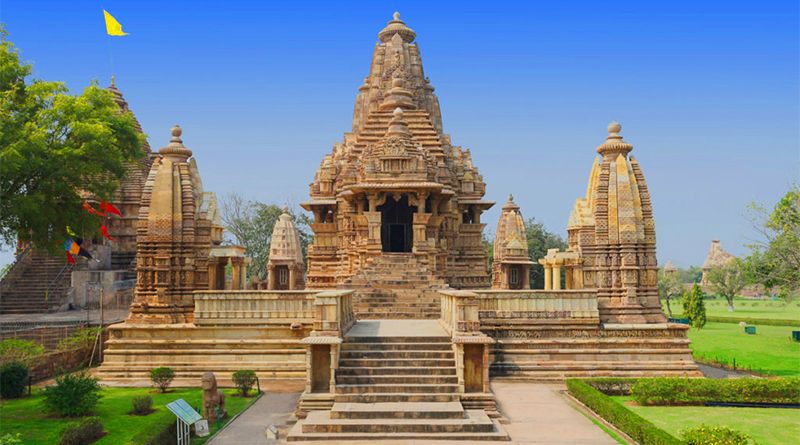
UNESCO dates the Khajuraho temples to the Chandela kings’ peak, between 950 and 1050 CE, and inscribed them in 1986. The best-known group, the Western Group, stands in a fenced garden, and its sculpture covers every level of each spire.
The stairs to each shrine are steep and narrow; cotton clothing that covers the knees suits both the climb and the temples. Poha with jalebi is the standard Madhya Pradesh breakfast.
- Entry: ₹40 Indian, ₹600 foreign (the ASI Category A rate; no official page loaded, so confirm at the counter).
- Getting there: Khajuraho has its own airport and railway station; arrange pickups through your hotel.
- Finding the calm: the lawns inside the Western Group enclosure have shade trees between the temples.
The architect’s eye. Step back until a whole temple fits in view. The thousands of figures then read as one rising composition that carries the eye to the top of the spire.
Nearby and worth the detour
- The Eastern Group, a cluster of Jain temples on the other side of the village.
- Panna Tiger Reserve, close to Khajuraho, for a jeep safari in the open season.
7. Ajanta Caves, Maharashtra

UNESCO counts 30 caves, including unfinished ones, cut into a horseshoe-shaped cliff above the Waghora river. They were made in two phases, in the 2nd to 1st centuries BCE and the 5th to 6th centuries CE, and their wall paintings are among the earliest surviving Buddhist murals in India.
The paths between the caves are stepped stone, so wear supportive shoes. Misal pav, a spiced sprout curry with bread, is a Maharashtrian staple at the stalls near the site.
- Entry: ₹40 Indian, ₹600 foreign in cash (₹35 and ₹550 online). Closed on Mondays; open 9 am to 5 pm.
- Getting there: base yourself in Chhatrapati Sambhajinagar (formerly Aurangabad) and take an early state bus or taxi to the visitor centre, where shuttle buses run to the caves.
- Finding the calm: the unfinished caves towards the ends of the horseshoe can be quieter than the painted caves, including 1, 2, 16 and 17.
The architect’s eye. Give your eyes a minute inside a painted cave before looking closely. The low light that preserved the murals also hides their detail at first.
Nearby and worth the detour
- Ellora, whose Kailasa temple (Cave 16) UNESCO calls the largest monolithic temple.
- Bibi Ka Maqbara in Chhatrapati Sambhajinagar, a 17th-century tomb modelled on the Taj Mahal.
8. Konark Sun Temple, Odisha

The 13th-century temple was built as the chariot of the sun god, with 24 carved wheels and teams of stone horses. UNESCO, which inscribed it in 1984, gives six horses in one place and seven in another. UNESCO describes the temple as bathed in the rays of the rising sun.
The coastal sun is strong from March, so bring a hat. Raghurajpur, near Puri, is the village of Odisha’s Pattachitra painters. Chhena poda, baked caramelised cottage cheese, is Odisha’s best-known sweet.
- Entry: ₹40 Indian, ₹600 foreign in cash (₹35 and ₹550 online).
- Getting there: by road from Puri or Bhubaneswar, by state bus or taxi along the coast.
- Finding the calm: the casuarina plantations along the coast road, outside the temple grounds, give shade away from the crowds.
The architect’s eye. Study one wheel closely. UNESCO reads the wheels as symbols of the seasons and months; the popular claim that they work as sundials is not on its page.
Nearby and worth the detour
- Puri, the temple city of Jagannath, along the coast.
- Chilika Lake, the largest brackish water lagoon in Asia, where boats go out to see Irrawaddy dolphins.
The imperial landscapes
From the Vijayanagara capital to the Mewar hills and the colonial ports of Mumbai and Kolkata, these four sites show empires shaping whole landscapes and waterfronts.
9. Virupaksha Temple, Hampi

Hampi was the capital of the Vijayanagara Empire, and its ruins form the Group of Monuments at Hampi, inscribed by UNESCO in 1986. The Virupaksha Temple, dedicated to Shiva, is still in daily worship; its eastern gopuram, about 50 metres tall, stands at the head of the old bazaar street.
Temple dress rules apply: no shorts or sleeveless tops. Lambani women sell mirror-work embroidery near the temple. A South Indian thali on a banana leaf is the usual lunch in the village.
- Entry: no ASI ticket; the temple charges a small entry and camera fee at the gate. The Vittala Temple complex, with the stone chariot, is ticketed by the ASI, so check the current rate there.
- Getting there: Hospet (Hosapete) is the nearest railhead; agree a full-day rate with an auto-rickshaw driver before setting out, as the ruins are spread over a wide area.
- Finding the calm: Hemakuta Hill, above the temple, has small early shrines and open rock to sit on at sunrise.
The architect’s eye. Climb a nearby hill and look back. The shrines, boulders, tanks and market streets read as one planned sacred landscape rather than a set of separate buildings.
Nearby and worth the detour
- The Vittala Temple, with its stone chariot and pillared halls.
- Pattadakal, Aihole and Badami, the Chalukya temple sites; Pattadakal was inscribed by UNESCO in 1987.
10. Kumbhalgarh Fort, Rajasthan
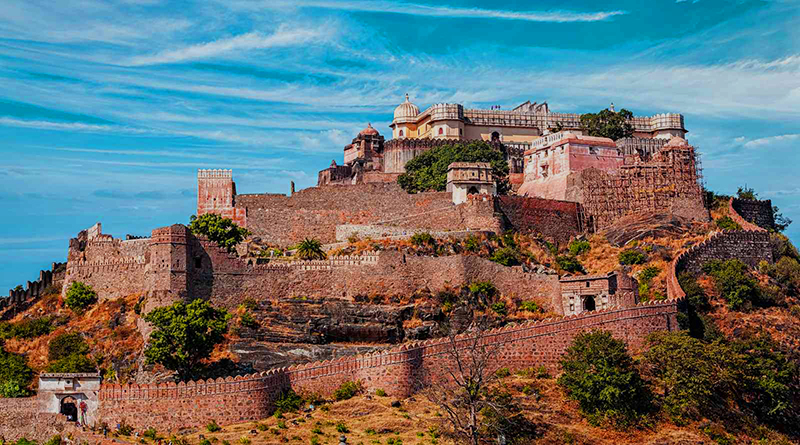
Rana Kumbha of Mewar began Kumbhalgarh in 1448, and its wall runs for about 36 kilometres across the Aravalli ridges, one of the longest continuous fortification walls in the world. The fort is one of the six Hill Forts of Rajasthan inscribed by UNESCO in 2013.
The climb to the Badal Mahal at the top is steep, so wear supportive shoes. Laal maas, a red-chilli mutton curry, is the Mewar dish to look for in the hotels near the fort.
- Entry: ticketed by the ASI; the fee could not be confirmed on an official page, so check at the gate.
- Getting there: there is no railway to the fort; hire a car from Udaipur and leave early to see the ramparts in the evening light.
- Finding the calm: the Neelkanth Mahadev temple, inside the walls, lies away from the main palace route.
The architect’s eye. Follow the wall along the ridgelines. It bends with every contour instead of forcing the hills into straight lines, so the terrain becomes part of the defence.
Nearby and worth the detour
- Ranakpur’s Jain temple, whose marble pillars are traditionally counted at 1,444.
- Udaipur, the lake city of the Mewar rulers.
11. Gateway of India, Mumbai

The Gateway commemorates the landing of King George V and Queen Mary at Apollo Bunder in 1911. George Wittet designed it in yellow basalt, and it was completed in 1924.
The harbour front is humid for most of the year. Irani cafes in the Fort and Colaba areas serve bun maska, a buttered bun, with chai.
- Entry: free; it is an open public space.
- Getting there: take a suburban train to Chhatrapati Shivaji Maharaj Terminus (CSMT) or Churchgate, then a taxi to Apollo Bunder.
- Finding the calm: the gardens of the Chhatrapati Shivaji Maharaj Vastu Sangrahalaya museum, a short walk north, are shaded and quiet.
The architect’s eye. Stand back far enough to frame the Gateway with the Taj Mahal Palace hotel. One was raised to greet a British king; the other was built by an Indian industrialist, and they face the same harbour.
Nearby and worth the detour
- Elephanta Caves, rock-cut Shiva temples on an island about 10 kilometres away, inscribed by UNESCO in 1987. The ferry takes about an hour; a new passenger jetty at Radio Club, beside the Gateway, is under development, so check where boats leave from before you go.
- Kanheri Caves, Buddhist caves inside Sanjay Gandhi National Park in north Mumbai.
12. Victoria Memorial, Kolkata

The memorial, faced in the same Makrana marble as the Taj Mahal, was formally opened on 28 December 1921. It combines a European domed plan with Mughal details and stands in 64 acres of gardens at the south end of the Maidan.
Kolkata is humid from March to October, so wear cotton. Kathi rolls and mishti doi, sweetened set yoghurt in a clay cup, are the city’s two standard snacks.
- Entry: ₹50 Indian, ₹100 SAARC, ₹500 foreign for the galleries; the gardens alone cost ₹30. Galleries open 10 am to 6 pm and close on Mondays and national holidays; gardens open daily.
- Getting there: Kolkata Metro to Maidan station, then a short walk.
- Finding the calm: the western side of the gardens, under the large trees, is usually quieter than the paths by the main entrance.
The architect’s eye. Walk round the building rather than viewing it only from the front. Classical symmetry gives way to Mughal-style domes and kiosks as the angle changes.
Nearby and worth the detour
- St Paul’s Cathedral, a short walk across the road to the east.
- The Indian Museum, founded in 1814 and among the oldest and largest museums in India.
The Himalayan frontier
Ladakh and Sikkim hold royal sites built far from the plains, at altitude and in forest.
13. Basgo Monastery, Ladakh

Basgo was a seat of the Namgyal kings, and its Maitreya temples date from the late 16th to early 17th centuries. The Serzang temple is dated to about 1624, in the reign of Sengge Namgyal. Each temple holds a large seated Maitreya Buddha surrounded by murals.
Nights are cold even in summer, so carry warm, windproof layers. Thukpa, a Tibetan noodle soup, is served in most Ladakhi kitchens.
- Entry: a small fee is reported; confirm locally, as no official tariff was found.
- Getting there: Basgo is on the Leh to Kargil road, west of Leh; hire a driver in Leh or take a westbound bus and get off at the village.
- Finding the calm: the Serzang temple’s interior is dim and quiet between visitor groups.
- Health: Leh is at high altitude. Plan rest days after you arrive, and ask your doctor about altitude before you travel.
The architect’s eye. Look at the colour of the walls against the cliff. The builders used local earth, so the citadel reads as part of the ridge it stands on.
Nearby and worth the detour
- Alchi, whose temple murals are in an early Kashmiri style.
- Leh Palace, built in the 17th century above the old town of Leh.
14. Rabdentse Ruins, Sikkim

Rabdentse was the second capital of the Kingdom of Sikkim, from 1670 to 1814, and the ASI protects it as a monument of national importance. Its stone foundations and three chortens stand in forest below Pelling, with the Khangchendzonga range behind them on clear mornings, weather permitting.
The walk from the gate on the Pelling to Geyzing road takes about 15 minutes through forest, and the path is wet in the monsoon months. Pelling’s shops sell Tibetan thangka paintings. Phagshapa, strips of pork fat stewed with radish and dried chillies, is a Sikkimese dish.
- Entry: no fee was found in any official source; check at the gate.
- Getting there: shared jeeps link Pelling with Gangtok and the rest of Sikkim. Foreign nationals need a Restricted Area Permit to enter Sikkim, and some protected areas need extra permits; check the current rules with Sikkim Tourism before you go.
- Finding the calm: the forest path itself, between the gate and the ruins, is usually quiet in the early morning.
The architect’s eye. At the last viewpoint, look back at the ruins. The palace occupies a small clearing in a large forest, and the forest is closing back in on it.
Nearby and worth the detour
- Pemayangtse Monastery, on the ridge above the ruins.
- Yuksom, Sikkim’s first capital and the start of the Dzongri trek.
The island legacy
The Andaman Islands close the list with a site whose architecture was built for control rather than display.
15. Cellular Jail, Andaman Islands
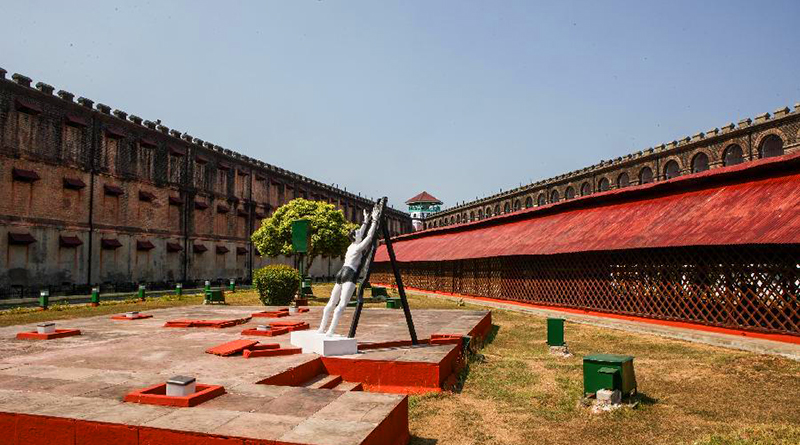
The British built the Cellular Jail between 1896 and 1906 to hold political prisoners in solitary cells; the sentence was known as Kala Pani, the black water. Three of its seven wings survive. It was declared a National Memorial in 1979 and has been on India’s UNESCO Tentative List since 2014.
The islands are hot and humid all year, so dress in loose cotton. Shops in the town sell coconut-shell handicrafts, and fresh seafood is on most local menus.
- Entry: ₹30 Indian, ₹100 foreign. The evening light and sound show costs ₹300 for adults and ₹150 for children aged 5 to 11 (Andaman Tourism fares).
- Getting there: fly to Veer Savarkar International Airport at Sri Vijaya Puram (formerly Port Blair); the jail is a short taxi ride away.
- Finding the calm: Marina Park, on the seafront below the jail, is a short walk downhill from the gate.
The architect’s eye. Stand at the base of the central tower and look along the wings. The radiating plan let a few guards watch hundreds of cells while preventing prisoners from seeing each other.
Nearby and worth the detour
- Ross Island, now Netaji Subhas Chandra Bose Dweep, a short boat ride away, with colonial ruins under banyan roots.
- Swaraj Dweep (Havelock Island), by ferry, for Radhanagar Beach.
Before you go
- Start early. Some ASI monuments open around sunrise and others later (Ajanta at 9 am, the Victoria Memorial galleries at 10 am), so check each site’s timings; early mornings are the coolest part of the day.
- Travel in regional circuits. Group nearby places, such as Agra with Delhi and Jaipur, or Hampi with Badami, to cut long transfers.
- Add the winter festivals. Rajasthan and Gujarat combine heritage with fairs: see our guides to the Pushkar Mela, the Rann Utsav in Kutch, and a Jaisalmer desert camp.
- Buy ASI tickets online. Online tickets are ₹5 cheaper for Indians and ₹50 cheaper for foreign visitors, and under-15s enter free.
- Dress for active temples. Virupaksha and Basgo are places of worship; cover shoulders and knees and follow photography rules.
- Save the helplines. Dial 112 for any emergency, 181 for the women’s helpline, and 1800-11-1363 or 1363 for the Ministry of Tourism’s 24-hour tourist helpline.
- Heat and altitude. Summer heat in the plains and the altitude in Ladakh both affect health; ask your doctor for advice before you travel.
TravelPep’s cut
These sites record how rulers, monks and colonial engineers solved problems of water, defence, faith and display, and each one makes more sense once you look at how it was built. Choose one circuit, start early, and allow extra time for a nearby garden, viewpoint or second monument. The UNESCO World Heritage list for India gives the official description of each inscribed property.
Frequently asked questions
What are the most famous historical places in India?
The Taj Mahal, Agra Fort, Qutub Minar, Ajanta, Khajuraho, Konark and Hampi are among the best known. All seven are inside UNESCO World Heritage properties.
How much does it cost to enter the Taj Mahal?
As of 7 November 2026, entry costs ₹50 for Indians, ₹540 for SAARC and BIMSTEC nationals and ₹1,100 for other foreign visitors. The main mausoleum is ₹200 extra.
Which day is the Taj Mahal closed?
The Taj Mahal is closed on Fridays. It opens 30 minutes before sunrise and closes 30 minutes before sunset on other days.
Are children free at ASI monuments?
Yes. Children under 15, Indian and foreign, enter Archaeological Survey of India monuments free.
Is it cheaper to buy ASI tickets online?
Yes. Online tickets cost ₹5 less for Indians and ₹50 less for foreign visitors than the cash rate.
What is the emergency number in India?
Dial 112, India’s national emergency number. The Ministry of Tourism runs a 24-hour tourist helpline on 1800-11-1363 or 1363.