Table of Contents
⚡ KEY TAKEAWAYS: Best Beaches in the World
- The best beaches in the world in this guide span 12 countries and territories, and several now ration access with tickets, caps, or closures.
- Navagio Beach on Zakynthos is closed to landings; Visit Greece lists disembarkation as not permitted (checked 6 November 2026).
- Maya Bay in Thailand closes every 1 August to 30 September, and swimming stays banned after its 1 October 2026 reopening.
- Pfeiffer Beach in Big Sur charges a US$15 day-use fee; its access road is open to motor vehicles only until 29 January 2027.
- The UK Foreign Office advises against all but essential travel to Cuba, home of Cayo Coco (25 September 2026).
| Key term | Meaning |
|---|---|
| Basalt column | A many-sided pillar of rock formed as lava cools and cracks, as at the Giant’s Causeway. |
| Bioluminescence | Light produced by living organisms, such as plankton that glow when waves disturb them. |
| Olivine | A green mineral that colours the sand at Papakōlea on Hawai’i Island. |
| Foraminifera | Tiny marine organisms whose crushed shells turn Harbour Island’s sand pink. |
| Shark Bay cockle | A small clam found only in Western Australia, whose shells form Shell Beach. |
| CONANP | Mexico’s national protected areas commission, which authorises tour operators at the Marietas Islands. |
| DHHL | Hawai’i’s Department of Hawaiian Home Lands, which manages the land around Papakōlea. |
| Day-use fee | A charge for visiting a site during the day without camping, as at Pfeiffer Beach. |
| Rip current | A strong, narrow current that flows away from the shore. |
| Tourist card | Cuba’s entry document for most visitors, linked to the passport. |
Thailand closed Maya Bay to visitors in June 2018 so that its coral could recover from thousands of boat arrivals a day, and the bay now shuts again every August and September. Off Zakynthos, Greece has kept people off Navagio’s sand since cliff falls were judged a landslide risk.
Information checked on 6 November 2026.
These 15 best beaches in the world span three oceans and 12 countries and territories, and each earns its place through a feature you can name in a few words: basalt columns, a shipwreck, shells in place of sand, light made by plankton.
What links them in 2026 is less the colour of the shore than the rules around it, from prebooked tickets on the Antrim coast to a single-lane road above Pfeiffer Beach that only cars may use. Each entry gives the fact that makes the beach worth the journey, then the access rule and, where a source supports them, the fee and a quiet corner, all checked on 6 November 2026.
Europe and the North Atlantic
1. Giant’s Causeway, Northern Ireland
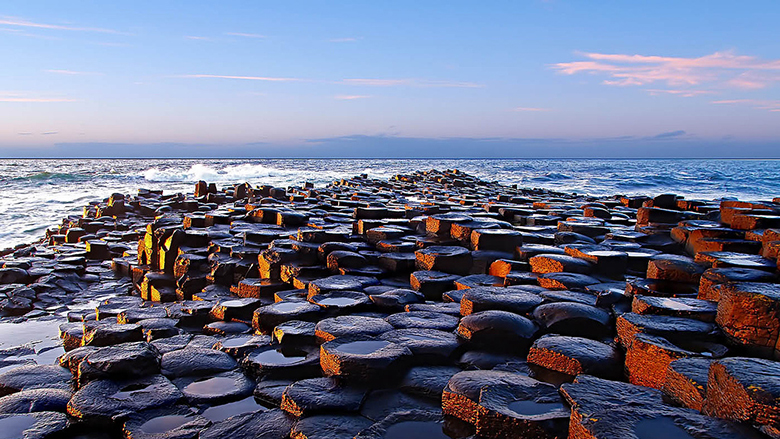
On the north coast of County Antrim, more than 40,000 basalt columns step down into the sea like the worn treads of some abandoned stair, the remains of lava that cooled and split some 60 million years ago (UNESCO; National Trust). This is a shore of stone rather than sand, and the stone is the reason to come. The National Trust warns of high winds on the exposed headlands, so a windproof layer belongs in the bag in every month.
Getting there and hours: The coastline is open from dawn to dusk. The Visitor Experience, with the exhibition and main car park, costs £15 for an adult, £7.50 for a child aged 5 to 17, and £37.50 for a family, and the National Trust’s page calls prebooking both “essential” and “strongly recommended” (checked 6 November 2026). Walkers without a Visitor Experience ticket use the separate Causeway Coast Way car park, which the Trust prices at “£12 per vehicle for walkers to access the network of coastal paths”.
Transport safety: The Shepherd’s Steps on the Red Trail are 162 steep stone steps with a handrail, and the Trust warns of unfenced cliff edges and rock falls. It also asks visitors not to push coins into the columns, which damages them.
2. Navagio Beach, Zakynthos, Greece
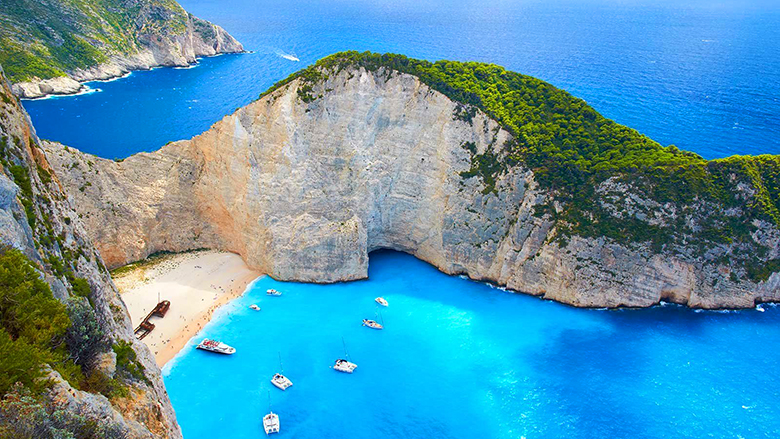
The rusting hull on Navagio is the Panagiotis, which ran aground in 1980, and white cliffs close the cove on three sides (Visit Greece). For most visitors the cove is now seen only from above. Geologists from Greece’s earthquake planning agency found a risk of extensive landslides, and a plan to extend the beach about 30 m seaward with gravel aims to protect the wreck, which lies about 25 m from the water (Euronews, 13 July 2026).
Getting there and hours: ⚠️ Closed to landings: Visit Greece lists the beach as closed, with disembarkation not permitted (checked 6 November 2026). The 2026 order, which also kept boats 50 m offshore, expired on 31 October 2026 (To Vima, 2 June 2026); arrangements for 2027 need a new government decision, and none had been published on the check date. The clifftop viewing platform above Anafonitria shows the cove from above but gives no access to the beach.
Transport safety: Only the main platform has a railing (Greek Trip Planner, July 2026), so stay behind it, however good the angle looks beyond.
3. Barceloneta Beach, Barcelona, Spain
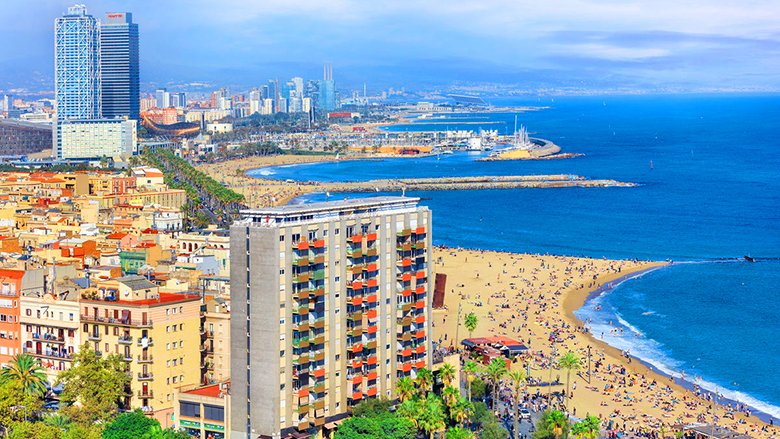
Barceloneta is a city beach in the plainest sense: 422 m of sand on Barcelona’s waterfront, with the city at your back rather than solitude in front (Barcelona City Council). The council credits the coastal works before the 1992 Olympics with readying it for the world, and Rebecca Horn’s sculpture L’estel ferit (The Wounded Star) stands on the sand.
Getting there and hours: Lifeguards work only in the bathing season, which ran from 30 May to 13 September in 2026, from 10:30 am to 7:30 pm, with shorter hours into early October (Barcelona City Council). Smoking has been banned on the beach since 30 July 2022, except at the beach bars.
Transport safety: The UK Foreign Office warns that street thieves in Spain work in teams and use distraction (28 October 2026). Take only what you need onto the sand, and never leave a bag unwatched while you swim.
Finding the calm: Parc de la Ciutadella, at Passeig de Picasso 21, opens daily from 7 am to dusk, with the Fontserè cascade, a boating lake, and the Umbracle, a shade house built in 1883.
The Indian Ocean, Asia, and Australia

4. Maya Bay, Koh Phi Phi Leh, Thailand
Limestone cliffs enclose Maya Bay on Koh Phi Phi Leh, in the Andaman Sea off Krabi, so that the water inside lies sheltered from the open sea. After the 2018 closure, rangers planted new coral and beach trees, and boats now moor at a jetty at Loh Samah on the far side of the island, from which a boardwalk leads to the sand (Tourism Authority of Thailand, November 2021).
Getting there and hours: ⚠️ Annual closure: the bay closes from 1 August to 30 September for reef recovery and monsoon safety, and it reopened on 1 October 2026 with swimming still banned (Thai government Public Relations Department; Time Out Bangkok, 29 September 2026).
Tour operators report a park fee of 400 baht for a foreign adult and visits of about an hour; confirm both with the national park before you go. Indian passport holders can check the current entry rules in our Thailand visa for Indians guide.
Transport safety: Before boarding a longtail or speedboat, agree the route, the stops, and whether the national park fee is included in the price.
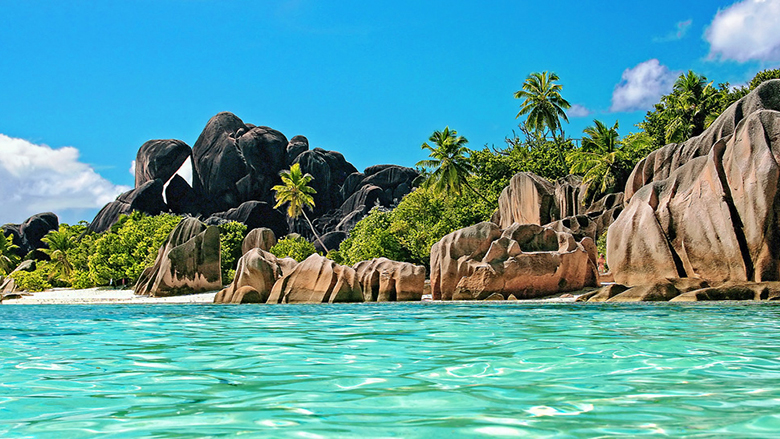
5. Anse Source d’Argent, La Digue, Seychelles
Granite boulders, rounded by weather and sea, divide Anse Source d’Argent into small coves of shallow, clear water on the island of La Digue. There is no road to the beach. You walk through L’Union Estate, an old plantation where an ox still turns the copra mill, vanilla climbs the trees, and Aldabra giant tortoises keep to a pen (SeyVillas).
Getting there and hours: Entry is through L’Union Estate, whose fee has been reported at SCR 150 (SeyVillas, undated). No official estate page was available, so check the fee at the gate.
Finding the calm: Veuve Special Reserve at Anse Réunion protects 21 ha of forest for the Seychelles black paradise flycatcher, with a nature trail and boardwalk. It opens Monday to Friday from 8 am to 4 pm and Saturday from 9 am to 3 pm, and non-citizens pay SCR 150 (Seychelles Parks and Gardens Authority).
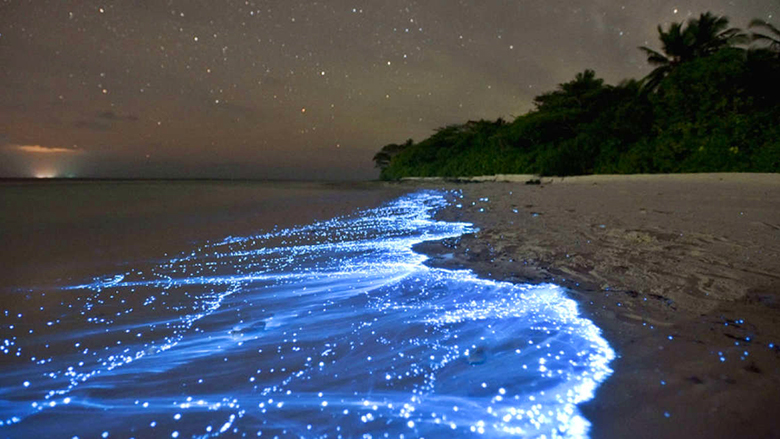
6. Vaadhoo, Raa Atoll, Maldives
Atlas Obscura attributes the blue light that washes onto Vaadhoo on some nights to bioluminescent plankton, Lingulodinium polyedrum, which glow when waves disturb them. It is not a fixed attraction. The glow depends on the plankton, the sea, and the darkness, and it can appear on other Maldivian islands too; travel guides describe it as most often reported between June and February, on moonless nights (aMaldives). A tripod and a long exposure give the best chance of recording it.
Getting there and hours: Vaadhoo lies about 194 km north of Malé. Travel guides list a domestic flight to Ifuru followed by a speedboat, or a speedboat of about three hours, with limited public ferries (aMaldives; not confirmed by an official source). Two Maldivian islands share the name, so book for Vaadhoo in Raa Atoll.
Access needs: No official accessibility information was found; ask your guesthouse about boat transfers and step-free routes before booking.
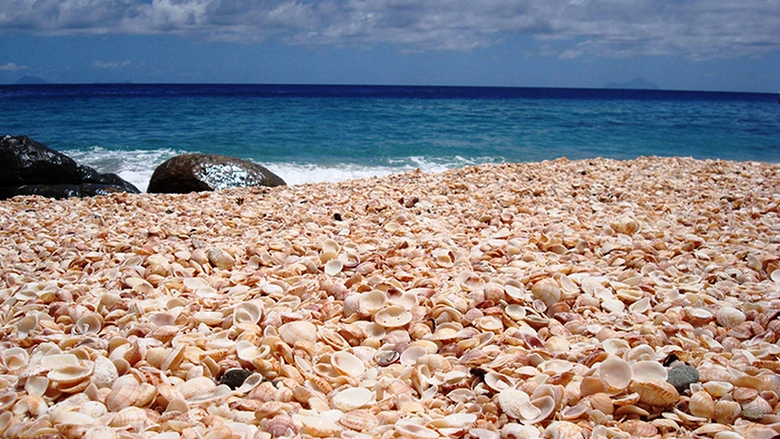
7. Shell Beach, Shark Bay, Western Australia
Shell Beach is made of shells, not sand: those of the Shark Bay cockle, a species found only in Western Australia and adapted to the bay’s unusually salty water (Parks and Wildlife Service WA).
The service says the shells lie up to 10 m deep, and gives their length as 60 km in one place and more than 70 km in another; either way, they run far beyond sight of the car park. Shark Bay was inscribed as a World Heritage Area in 1991.
Getting there and hours: Entry to Shell Beach Conservation Park is free, and pets are not allowed (checked 6 November 2026). The beach is on Shark Bay Road, about 45 km from Denham, and reachable in a two-wheel-drive car (Shark Bay Visit).
Transport safety: The parks service advises carrying a personal locator beacon in this remote region. Because H5 bird flu has been detected in Western Australia, it asks visitors to report sick or dead wildlife on 1800 675 888 rather than touch it.
The Americas and the Caribbean
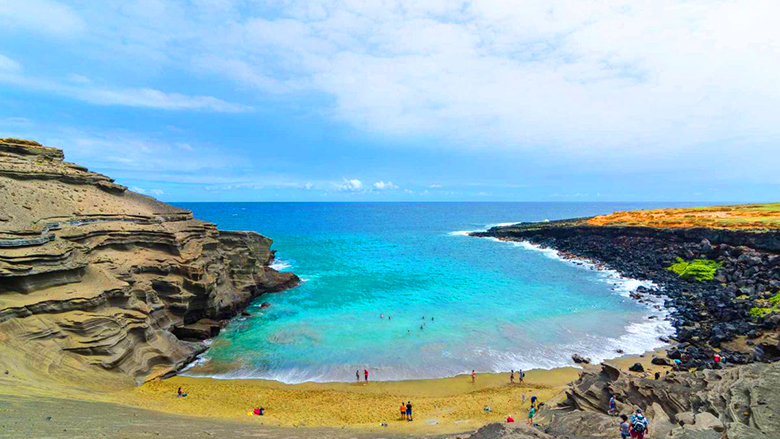

8. Papakōlea Green Sand Beach, Hawai’i Island
Papakōlea, near Ka Lae at the southern tip of Hawai’i Island, takes its olive colour from olivine crystals eroded out of Pu’u Mahana, a collapsed cinder cone now open to the sea (Hawaii Magazine). The walk is part of the visit: roughly 3.6 to 4.8 km each way across open, windswept grassland, depending on the source and the starting point.
Getting there and hours: The beach lies on Department of Hawaiian Home Lands land, which the department describes as conservation land “not suited for commercial activities” (KITV, 16 July 2024). Truck rides offered near the trail have been described as unapproved by the state, and vehicle tracks have eroded the route, so walking does the least damage.
Transport safety: ⚠️ Heat and exposure: there is no shade or drinking water, the last descent is about 12 m of loose scree, and there are no lifeguards (How to Live in Hawaii, 1 November 2026). Carry all the water you need, and if you have a heart condition, ask a doctor before a long walk in heat.
9. Hidden Beach, Marietas Islands, Mexico
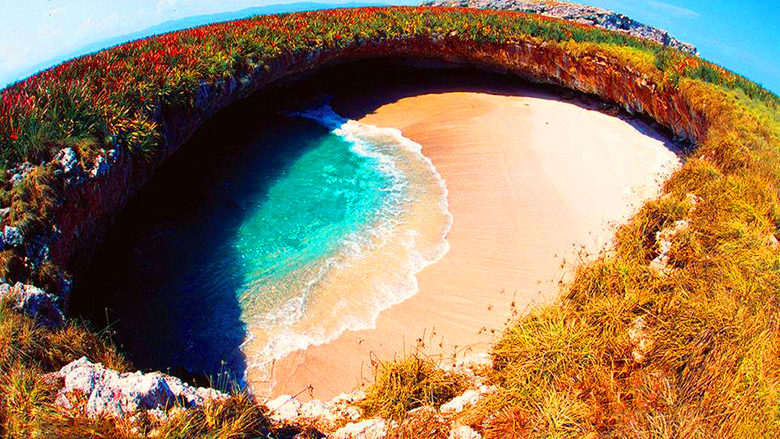
Playa del Amor, also called Playa Escondida, lies inside one of the Marietas, small volcanic islands off Nayarit that form a national park and a Ramsar wetland of 1,357 ha (Ramsar). The sand sits at the bottom of a hollow open to the sky, reached by swimming through a short sea tunnel; the hollow is widely said to have been blasted by military test explosions in the early 1900s, though no official source confirms it.
The beach closed from 9 May to 31 August 2016 so that its reef could recover (Riviera Nayarit).
Getting there and hours: ⚠️ Rules not confirmed by CONANP, the national parks agency: Mexican media report a cap of 116 visitors a day, closures on most Mondays and Tuesdays, compulsory life jackets and helmets, a ban on non-biodegradable sunscreen, and a conservation fee of MXN 125 (Food & Pleasure, 8 August 2026). Treat them as reported, not guaranteed.
Book only with an operator that can show CONANP authorisation, and confirm the day’s rules with it. Bring a waterproof camera rather than anything you cannot swim with.
10. Pfeiffer Beach, Big Sur, California, USA
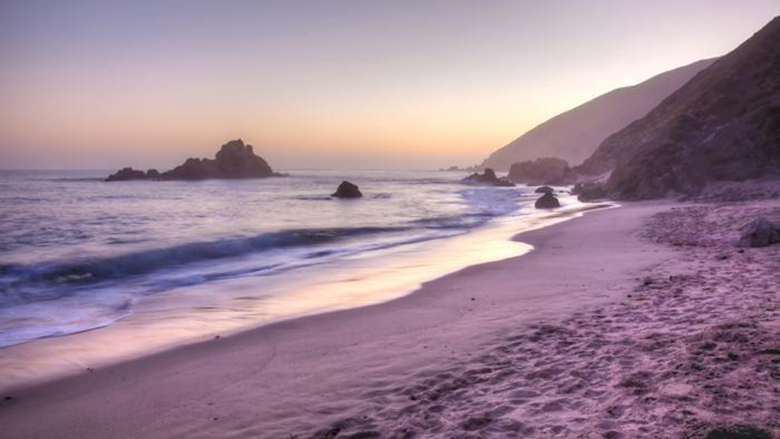
Pfeiffer Beach, in Los Padres National Forest, is known for Keyhole Rock, an offshore stack the surf runs through, and for streaks of purple in its sand. The cause of the colour is disputed: Visit California credits manganese, while the mineral study site Sand Atlas finds garnet mostly responsible, and no Forest Service page names it. From June to August the beach is often foggy and cold (USDA Forest Service).
Getting there and hours: Day use costs US$15 (USDA Forest Service, updated 3 November 2026). Access is by Sycamore Canyon Road, a single-lane road of 3.5 km off Highway 1, which until 29 January 2027 is open to motor vehicles only.
The car park holds 65 vehicles and is usually full on summer and holiday weekends. The same page publishes conflicting hours, 9 am to 8 pm and sunrise to sunset, so check the current information with the Forest Service before you drive down. Highway 1 reopened through Regent’s Slide on 14 January 2026, but Caltrans warns of occasional full closures after storms.
Transport safety: There are no toilets or drinking water, and the Forest Service warns that swimming is hazardous because of cold water, rocks, and unpredictable rip currents.
11. Santa Monica State Beach, California, USA
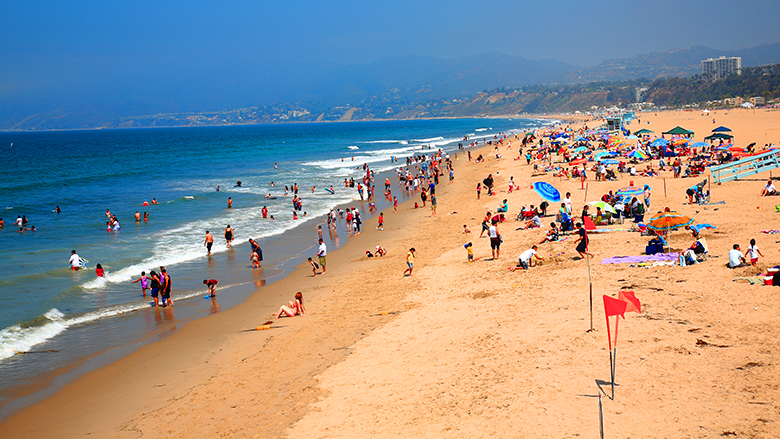
Santa Monica Pier opened on 9 September 1909, built to carry sewage pipes beyond the surf before it became a pleasure pier; its Looff Hippodrome dates from 1916, and the carousel inside from 1922 (Santa Monica Conservancy). The beach runs about 5.6 km, and the Marvin Braude bike trail sets off from here on its 35 km run south to Torrance (Santa Monica Travel and Tourism).
Transport safety: Swim near an open lifeguard tower, keep away from the pier and the rocks, and if a rip current pulls you, swim parallel to the shore first (LA County Fire Lifeguards).
Finding the calm: Palisades Park runs along the bluff on Ocean Avenue, about 10.5 ha of lawns open daily from 5 am to midnight (City of Santa Monica). Further north, the Annenberg Community Beach House at 415 Pacific Coast Highway, built in the 1920s for the actress Marion Davies, has been open to the public since 2009 and needs no membership.
12. South Beach, Miami Beach, Florida, USA
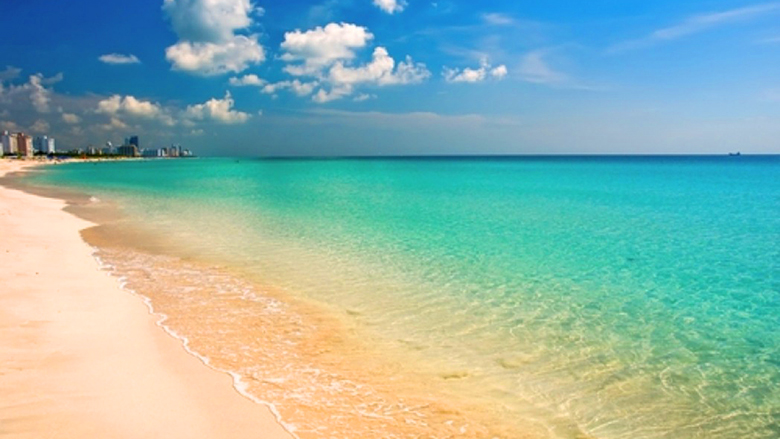
Behind South Beach stands the Miami Beach Architectural District, where more than 800 buildings were listed on the US National Register of Historic Places on 14 May 1979, after a campaign led by Barbara Baer Capitman (City of Miami Beach). The sand is the Atlantic edge of that Art Deco district.
Getting there and hours: The city’s free South Beach Trolley runs from 8 am to 11 pm daily, about every 20 minutes, on two loops (City of Miami Beach, updated 18 August 2026). Citi Bike is the city’s official bike-share scheme.
13. Seven Mile Beach, Grand Cayman
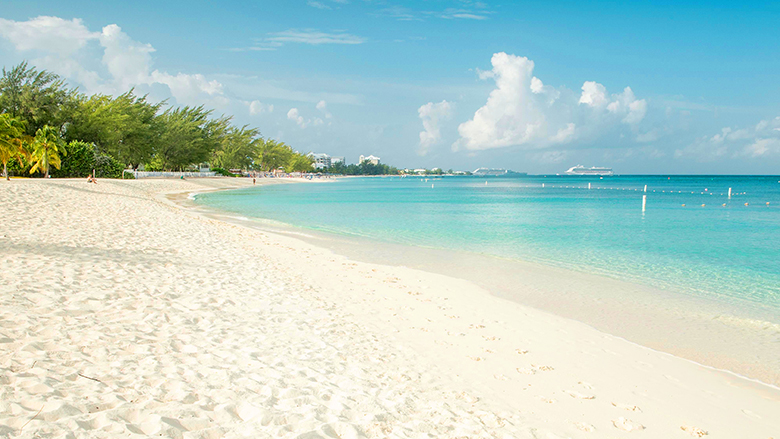
Despite its name, Seven Mile Beach on Grand Cayman’s western shore is about 8.9 km long, roughly 5.5 miles (Explore Cayman). Public access points include Public Beach on West Bay Road, Governor’s Beach beside the Governor’s residence, and West Bay Public Beach.
Transport safety: Taxi fares on Grand Cayman are set by government regulation (Cayman Islands Government, 2019). Ask the driver to confirm the fare, and its currency, before you set off.
Finding the calm: Cemetery Beach in West Bay, at the northern end, is less crowded and has reef just offshore, though currents can be strong (Explore Cayman, 7 September 2026).
14. Pink Sands Beach, Harbour Island, Bahamas
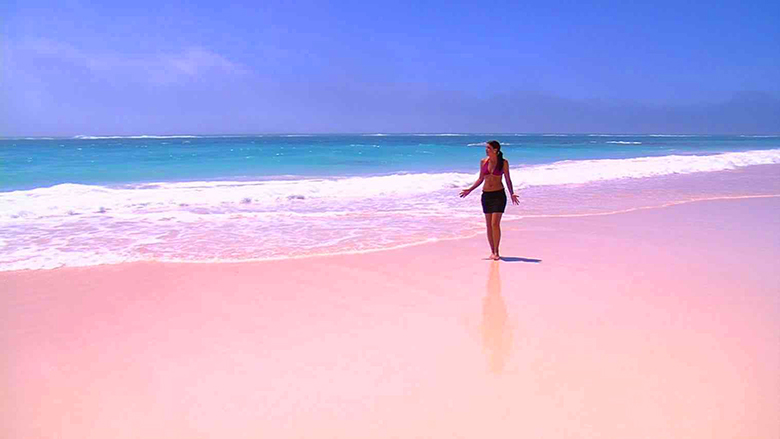
Pink Sands Beach runs for more than 4.8 km along the Atlantic side of Harbour Island, 15 to 30 m wide (Bahamas Ministry of Tourism). The colour comes from the crushed shells of foraminifera, tiny marine organisms, and shows most strongly in the wet sand at the water’s edge, so walk the tideline rather than the dry upper beach.
Getting there and hours: Fly to North Eleuthera from Nassau, then take the five-minute ferry; on the island, people get around by golf cart, bicycle, scooter, or on foot (Bahamas Ministry of Tourism).
Transport safety: Traffic in the Bahamas keeps left, though most cars are left-hand drive, so look right first when crossing. The UK Foreign Office describes water-sports operators as poorly regulated (28 May 2026); check equipment and insurance before you hire.
15. Cayo Coco, Cuba
Cayo Coco, in the Jardines del Rey archipelago off Cuba’s north coast, is joined to the mainland by a causeway across the bay. Cuba’s state tourism site gives its length as 17 km and PBS as about 19 km; this guide uses the Cuban figure. PBS also reports that the causeway blocked tidal flow and killed mangroves. Playa Pilar, named after Ernest Hemingway’s boat, lies on neighbouring Cayo Guillermo (Cubatravel).
Getting there and hours: ⚠️ Travel advisory: the UK Foreign Office advises against all but essential travel to Cuba because repeated power-grid collapses and fuel shortages disrupt transport, medical care, and water (25 September 2026).
Several Cayo Coco hotels closed temporarily in February 2026 when Cuba ran short of jet fuel (CiberCuba, 11 February 2026). US rules generally prohibit US persons from travelling to Cuba for tourism (OFAC). India’s visa agreement with Cuba exempts only diplomatic passports, so holders of ordinary Indian passports should check tourist-card rules with the Cuban embassy before booking.
Emergency numbers by beach
Each number below comes from the government source named beside it, checked on 6 November 2026.
| Beach | Country | Emergency numbers | Source |
|---|---|---|---|
| Giant’s Causeway | United Kingdom | 999 or 112 | nidirect (NI government) |
| Navagio | Greece | 112 | General Secretariat for Civil Protection |
| Barceloneta | Spain | 112 | UK Foreign Office |
| Maya Bay | Thailand | 191 police; 1669 ambulance; 199 fire; 1155 Tourist Police | UK Foreign Office |
| Anse Source d’Argent | Seychelles | 999 police, fire, and ambulance; 151 ambulance | Government of Seychelles |
| Vaadhoo | Maldives | 119 police; 102 ambulance; 118 fire | Government of Canada |
| Shell Beach | Australia | 000 | Australian Department of Infrastructure |
| Papakōlea, Pfeiffer, Santa Monica, South Beach | United States | 911 | National 911 Program |
| Hidden Beach | Mexico | 911 | Embassy of Spain in Mexico |
| Seven Mile Beach | Cayman Islands | 911 | Hazard Management Cayman Islands |
| Pink Sands Beach | Bahamas | 911 or 919 | Royal Bahamas Police Force |
| Cayo Coco | Cuba | 106 police; 104 ambulance; 105 fire | UK Foreign Office |
Planning a trip around these beaches
Daily budgets differ too much across 12 countries and territories to band honestly here. Access fees are the one cost that compares, from nothing at Shell Beach to £15 for the Visitor Experience at the Giant’s Causeway. The larger cost is time: a closed season, a reported daily cap, or a 65-car car park decides more visits than the price does.
If one of these coastlines is your honeymoon setting, our guide to honeymoon activities covers how to pace the trip, and our New Zealand honeymoon guide sets out a two-island route.
Quick Insights: Best Beaches in the World at a Glance
- The Giant’s Causeway coastline is open from dawn to dusk, and the National Trust strongly recommends prebooking its £15 Visitor Experience.
- Entry to Shell Beach Conservation Park in Western Australia is free, and pets are not allowed.
- Pink Sands Beach on Harbour Island looks pinkest in the wet sand at the water’s edge.
- Seven Mile Beach on Grand Cayman is about 8.9 km long, not seven miles.
- Papakōlea Green Sand Beach is a walk of roughly 3.6 to 4.8 km each way, with no shade or water.
- Hidden Beach in the Marietas Islands is reached only with a CONANP-authorised operator, by swimming through a tunnel.
- Barceloneta has lifeguards only in the bathing season, which ran from 30 May to 13 September in 2026.
FAQ
What is the best beach in the world?
No universally recognised ranking of the world’s best beaches exists. The best choice depends on what you value: unusual geology, swimming, wildlife, or easy access. This guide picks 15 for a distinctive feature each, from basalt columns to pink sand.
Can you swim at Maya Bay?
No. Swimming at Maya Bay remains banned after its reopening on 1 October 2026, according to Time Out Bangkok (29 September 2026). The bay also closes every year from 1 August to 30 September.
Is Navagio Beach open?
Navagio Beach is closed to landings: Visit Greece lists disembarkation as not permitted (checked 6 November 2026). Visitors can still see the shipwreck from the clifftop viewing platform above Anafonitria.
Which beach has purple sand?
Pfeiffer Beach in Big Sur, California, has streaks of purple sand. Sources disagree on the cause, crediting manganese or garnet. Day use costs US$15 (USDA Forest Service, 3 November 2026).
Why is the sand pink on Harbour Island?
The pink comes from the crushed shells of foraminifera, tiny marine organisms, mixed into the sand. The Bahamas Ministry of Tourism says the colour is strongest in wet sand at the water’s edge.
Is it safe to visit Cayo Coco in Cuba?
The UK Foreign Office advises against all but essential travel to Cuba because of power-grid collapses and fuel shortages (25 September 2026). Check your own government’s advice and your travel insurance before booking.