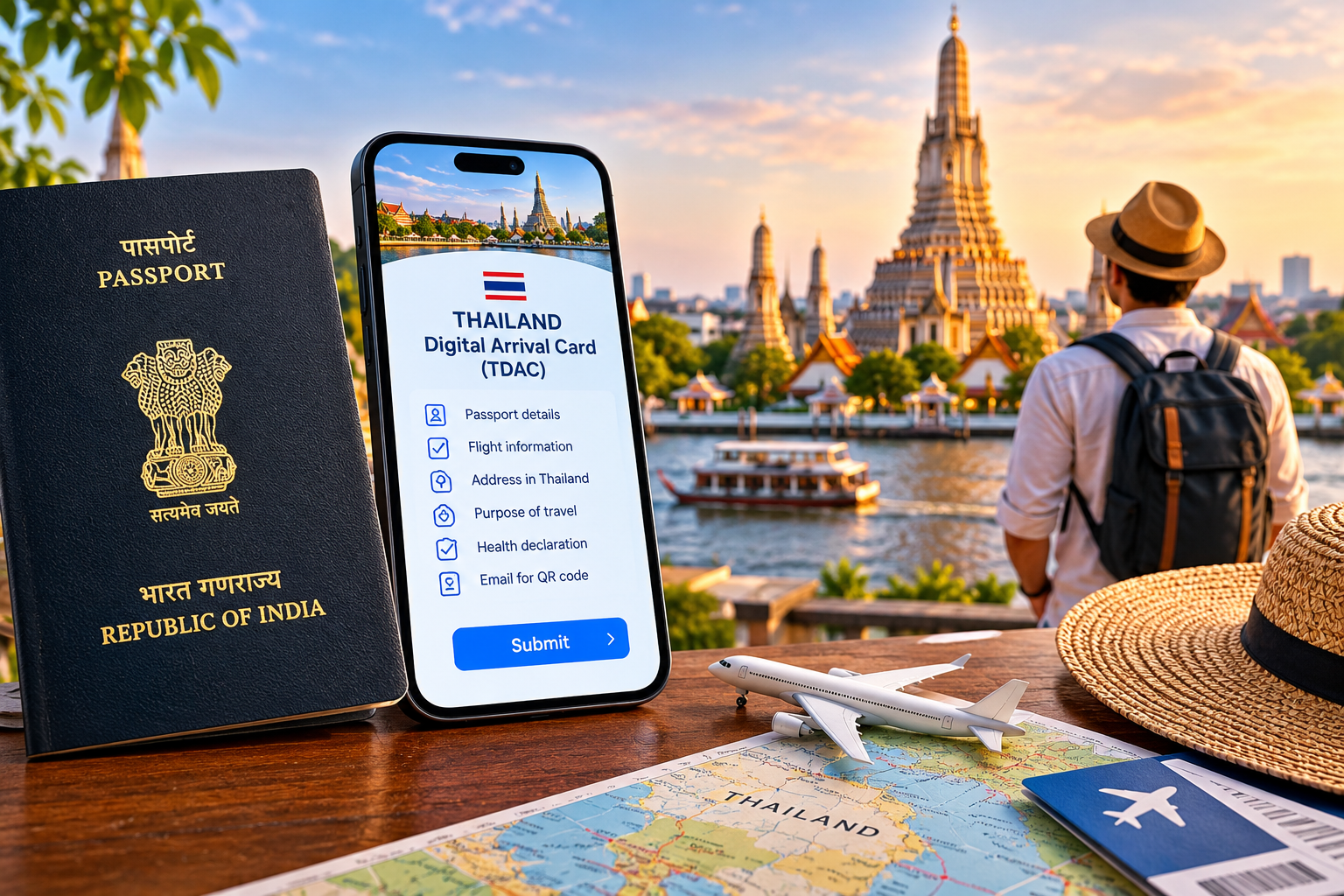
Table of Contents
⚡ KEY TAKEAWAYS: Thailand Visa for Indians
- Thailand visa for Indians: since 15 September 2026, Indian passports get 30 days visa-free for tourism, with no fee and no visa on arrival.
- File the free Thailand Digital Arrival Card (TDAC) at tdac.immigration.go.th within 3 days before arrival, for every entry.
- Carry at least 20,000 baht cash per person (about ₹57,000 on 29 October 2026), plus a return ticket and hotel bookings, says India's Bangkok embassy.
- Staying longer: a ₹3,000 tourist e-Visa allows 60 days; a 30-day extension for 1,900 baht is reported but not guaranteed.
- Overstaying costs 500 baht a day, capped at 20,000 baht, and re-entry bans start after 90 days.
| Key term | Meaning |
|---|---|
| Visa exemption | Entry without a visa, granted at the border; 30 days for Indians from 15 September 2026. |
| TDAC | Thailand Digital Arrival Card, a free online form filed within 3 days before each arrival. |
| Visa on arrival | A paid visa issued at the airport; since 15 September 2026, only for Azerbaijan, Belarus, and Serbia. |
| Royal Gazette | Thailand's official government journal, where the 2026 visa rules were published on 31 August. |
| Tourist visa (TR) | An e-Visa applied for before travel, allowing 60 days per entry; ₹3,000 for single entry in India. |
| DTV | Destination Thailand Visa: valid five years, 180 days per entry, ₹30,000 in India. |
| TM.7 | The form used to request an extension of stay at an immigration office in Thailand. |
| Overstay | Staying past the last date on your entry stamp; fined at 500 baht a day. |
| Proof of funds | Cash or equivalent that immigration officers may ask to see on arrival. |
From 15 September 2026, an Indian passport qualifies for 30 days in Thailand without a visa, half the 60-day scheme that ended the day before. The average Indian visitor stayed 6.98 nights this year, well within the new limit; the trips that need planning are those that run past day 30.
Information checked on 29 October 2026.
Thailand now offers Indians visa exemption: no visa application, no visa fee, and up to 30 days for tourism. It still comes with paperwork. Every traveller files a digital arrival card before landing, and immigration officers can ask to see a return ticket, hotel bookings, and cash. If your trip could run past 30 days, decide before you book your return flight, not at the immigration counter.
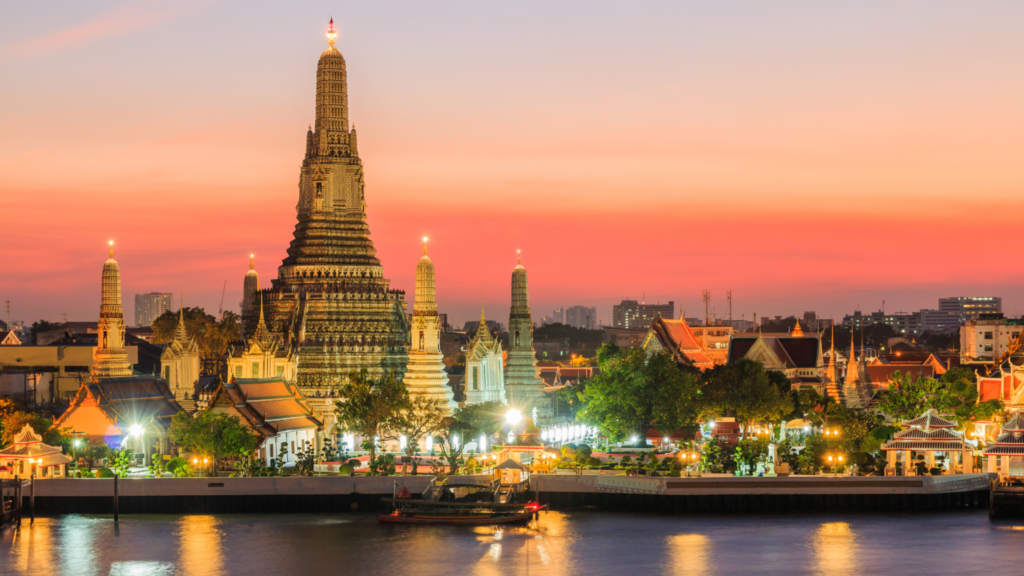
What changed for Indian passports on 15 September 2026
The Ministry of Interior published the announcements behind the change in Thailand’s Royal Gazette on 31 August 2026, and they took effect 15 days later. They ended the 60-day exemption and placed India on a list of 60 countries and territories allowed visa-free stays of up to 30 days for tourism. The Tourism Authority of Thailand’s announcement prints the full list.
India is not on the visa-on-arrival list. That list now holds three countries: Azerbaijan, Belarus, and Serbia.
The confusion has a history. Thailand’s first announcement of the overhaul in May 2026 put Indians on the visa-on-arrival list, and Google searches in India for a Thailand visa peaked the week of 24 May. On 14 July, the Cabinet reversed course and approved the 30-day exemption instead, according to the Royal Thai Embassy in New Delhi. Anyone who entered before 15 September keeps the stay stamp in their passport.
Old information outlives the rules it describes. The Royal Thai Consulate-General in Kolkata still carries an advisory, dated 11 November 2025, promising Indians 60 days. A commercial site with an embassy-like name still lists India under visa on arrival, on a page last updated in March 2024. Read the date on a page before you trust the number on it.
Two limits come with the exemption:
- Purpose. The Tourism Authority of Thailand and the Royal Thai Embassy in New Delhi both announced an exemption on 15 September 2026 for tourism. The same embassy’s visa page, updated a day later, says “tourism and short-term business engagements”. If your trip involves any business, confirm with the embassy before you rely on the exemption.
- Land borders. Entries under the 30-day exemption through land checkpoints are generally limited to two per calendar year.
The Embassy of India in Bangkok also advises anyone with a job offer in Thailand not to use the exemption.
Count your days before you book
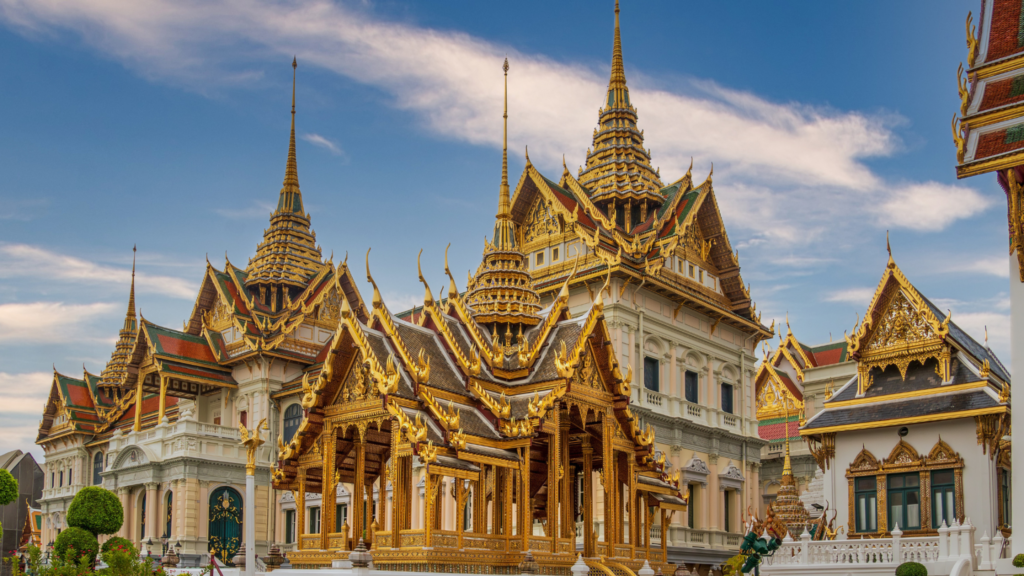
Thailand recorded 1,896,058 Indian arrivals between 1 January and 26 October 2026, and those visitors stayed an average of 6.98 nights, according to the Tourism Authority of Thailand. Nearly two in three (65.77 per cent) were on their first visit. A one-week holiday sits well inside 30 days.
The trips that strain the rule are the long ones: a wedding with a holiday attached, a month of island-hopping, a family visit with no fixed end. For those, settle the route before you pay for flights, because your planned return date has to fit within the permitted stay.
| If your trip lasts | The route that fits | Arrange it |
|---|---|---|
| Up to 30 days | Visa exemption | Nothing in advance except the TDAC |
| 31 to 60 days, plans may change | Exemption, then a 30-day extension | In Thailand, at an immigration office; not guaranteed |
| 31 to 60 days, fixed dates | Single-entry tourist visa (60 days) | Online, before you travel |
| Several trips in six months | Multiple-entry tourist visa | Online, before you travel |
| Long stays as an eligible remote worker or activity participant | Destination Thailand Visa (DTV) | Online, before you travel |
Your last day of stay is the one on your entry stamp, not the one you calculated at home. Read it at the counter, and if it looks wrong, raise it with the officer before you walk away.
Thailand Digital Arrival Card (TDAC): file it within 3 days
The Thailand Digital Arrival Card replaced the old paper TM6 card. It is not a visa. Every foreign traveller must file it, including visa-exempt Indians, and a new card is needed for every entry, according to the Royal Thai Embassy in Abuja.
The rules are short:
- When: within 3 days before arrival, including the arrival date, according to the Immigration Bureau’s FAQ. Children and infants need their own card.
- Where: the Immigration Bureau’s portal at tdac.immigration.go.th, or its THIM app.
- Cost: nothing. The embassy warns against fraudulent sites and tells travellers never to pay.
The form asks for passport details, your flight number and arrival date, your address in Thailand, the purpose of travel, a health declaration, and an email address for the QR code.
The timing catches overnight travellers. The Kochi flight to Bangkok lands at 3:55 am, so you file the card at home, not in the arrivals hall. File it once your flight is confirmed and you know where you will spend the first night, then keep the QR code on your phone and a printout in your bag.
Any site that asks you to pay for the card is not the government’s. If the official portal fails, the FAQ advises keeping a screenshot of the error and showing it to airport or immigration staff.
What Thai immigration can ask you to show
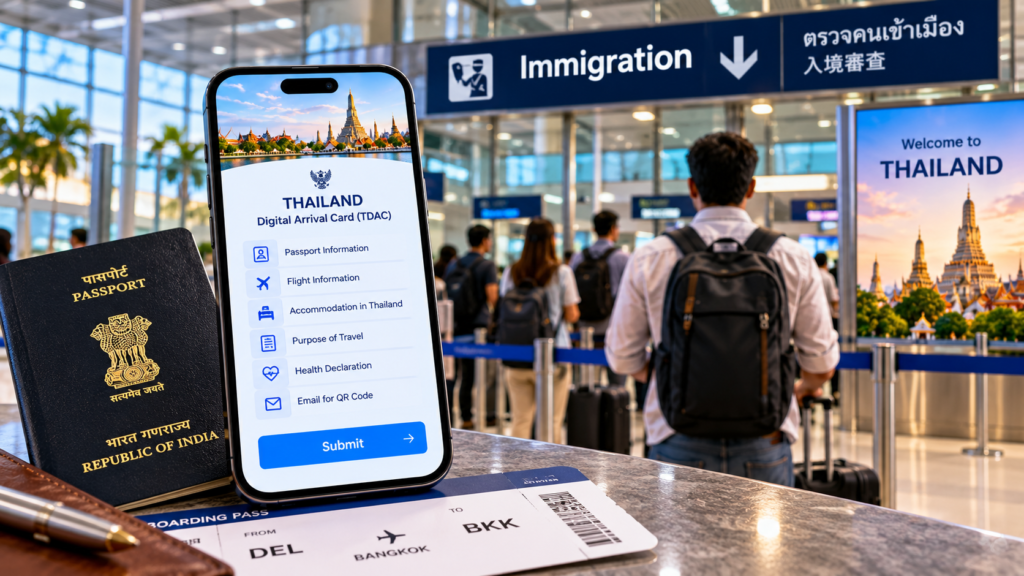
Thai immigration officers decide entry at the checkpoint, and the Tourism Authority of Thailand says the final decision rests with them. Visa-free entry is a permission they grant on arrival, not a right you carry from home.
The Embassy of India in Bangkok’s advisory tells Indian travellers to carry:
| Item | What to have ready |
|---|---|
| Passport | At least six months’ validity from the date of arrival |
| Return or onward ticket | Confirmed, within your permitted stay |
| Accommodation | Hotel bookings for the trip |
| Itinerary | A clear plan of where you will go |
| Cash | At least 20,000 baht per passenger |
| TDAC | The QR code from the official portal |
At 2.86 rupees to the baht (mid-market, checked 29 October 2026), 20,000 baht is about ₹57,000. Forex counters sell baht above the mid-market rate, so budget a little more.
Thailand’s own published amounts differ. The Ministry of Interior and the Tourism Authority of Thailand set 10,000 baht per person, or 20,000 per family, for certain visa-exempt cases. Children under 12 are exempt, and travellers may show baht, another currency, or payment documents. This guide follows the Indian Embassy’s 20,000 baht per person figure for Indian travellers.
Officers don’t check every arrival, but they can. In a group, the embassy adds, every member carries their own documents. If you are still choosing return dates, our guide to finding cheap flights covers when fares tend to drop.
Staying longer than 30 days
There are two lawful ways to stay past day 30: extend the exemption inside Thailand, or arrive on a visa that already allows more time.
Extend the exemption. Reports since the change, citing the Thai embassies in Washington and Brussels, say travellers on the 30-day exemption may request one extension of up to 30 more days at an immigration office in Thailand. The application uses form TM.7 and costs 1,900 baht (about ₹5,400). Approval is the officer’s decision, so a trip planned for day 45 shouldn’t depend on the extension.
Apply for a visa before you go. The Royal Thai Embassy in New Delhi says Indians planning tourist stays longer than 30 days should apply for an e-Visa. The embassy requires every applicant to apply through thaievisa.go.th.
| Visa | Fee | Valid for | Stay per entry |
|---|---|---|---|
| Tourist (TR), single entry | ₹3,000 | 3 months | 60 days |
| Tourist (TR), multiple entry | ₹13,500 | 6 months | 60 days |
| Destination Thailand Visa (DTV) | ₹30,000 | 5 years | 180 days |
Fees are from the Royal Thai Embassy in New Delhi’s visa page (checked 29 October 2026). The DTV is meant for remote workers and freelancers, and for people joining activities such as Thai boxing, cooking classes, or medical treatment; it is not a longer tourist visa.
The embassy links an FAQ and a list of common application mistakes from that page, and asks applicants to read both. Apply before you buy non-refundable tickets: if the e-Visa is refused, only the 30-day exemption remains, and the officer still decides entry.
Overstay fines and entry bans
Overstaying costs 500 baht a day (about ₹1,400), up to a maximum of 20,000 baht, according to Thailand’s government information portal. Travellers who declare an overstay at the immigration checkpoint pay the fine there before leaving.
The fine stops rising at day 40. The risk does not. Bans start once an overstay passes 90 days, under Ministry of Interior Order 1/2558, in force since 20 March 2016, according to the Royal Thai Embassy in Ho Chi Minh City:
| Overstay, declared at departure | Re-entry ban |
|---|---|
| More than 90 days | 1 year |
| More than 1 year | 3 years |
| More than 3 years | 5 years |
| More than 5 years | 10 years |
Travellers arrested for overstaying face a 5-year ban for less than a year over, and 10 years beyond that.
A missed flight or an illness can push anyone a day past the stamp. If you need more time, apply at an immigration office while your stamp is still valid; an extension is not guaranteed.
New direct flights from Kochi and Visakhapatnam
Air India Express added two nonstop routes to Bangkok’s Suvarnabhumi Airport in October 2026. As of 1 October, 11 airlines ran 427 weekly flights between India and Thailand, according to the Tourism Authority of Thailand.
| Route | Days | Departs | Arrives | Schedule from |
|---|---|---|---|---|
| Kochi to Bangkok | Tue, Thu, Sat, Sun | 10:15 pm | 3:55 am (next day) | 25 October 2026 |
| Bangkok to Kochi | Mon, Wed, Fri, Sun | 4:55 am | 7:40 am | 25 October 2026 |
| Visakhapatnam to Bangkok (IX0904) | Tue, Fri | 11:35 am | 4 pm | 27 October 2026 |
| Bangkok to Visakhapatnam (IX0903) | Twice weekly | 2:10 am | 3:55 am | October 2026 |
All times are local. Both routes were filed as winter routes, and Kochi airport’s winter schedule runs to 28 March 2027. Confirm the timetable before booking travel after that date.
Quick Insights: Thailand Visa for Indians at a Glance
- Indians who entered Thailand on or before 14 September 2026 keep the stay stamped at that entry.
- The land-border limit is generally two visa-exempt entries per calendar year.
- Children under 12 are exempt from Thailand’s proof-of-funds rule.
- A multiple-entry tourist visa costs ₹13,500 and allows 60 days per entry over six months.
- Business travellers should confirm with the Royal Thai Embassy in New Delhi before relying on the exemption.
- Kochi has four weekly nonstops to Bangkok, and Visakhapatnam has two, from late October 2026.
FAQ
Is Thailand visa-free for Indians?
Yes. Since 15 September 2026, Indian ordinary passport holders can enter Thailand visa-free for tourism and stay up to 30 days. There is no fee, but you must file the TDAC before arrival.
Do Indians get a visa on arrival in Thailand?
No. Thailand’s visa-on-arrival list now covers only Azerbaijan, Belarus, and Serbia. Indians use the 30-day visa exemption or apply for an e-Visa before travelling.
How much cash do I need to enter Thailand from India?
The Indian Embassy in Bangkok advises at least 20,000 baht per passenger. That was about ₹57,000 on 29 October 2026. Officers may not ask, but they can.
When should I fill in the TDAC?
File it within 3 days before you arrive, including the arrival date, on tdac.immigration.go.th or the THIM app. It is free, and you need a new card for every entry.
Can I extend the 30-day visa-free stay?
Possibly, once. Reports citing the Thai embassies in Washington and Brussels say you may request up to 30 more days at an immigration office in Thailand. The fee is 1,900 baht, and approval is at the officer’s discretion.
Can I enter Thailand visa-free twice in one month?
The published limit applies only to land borders: two exemption entries per calendar year. For air arrivals, Thailand’s announcement sets no number, but the officer decides each entry. Frequent short entries can draw questions.
Who should apply for the Destination Thailand Visa?
The DTV suits remote workers, freelancers, and people joining activities such as Thai boxing or cooking courses. It costs ₹30,000 in India and allows 180 days per entry.