
Argentina vs Spain FIFA World Cup Final Travel Guide: Stadium, Transit & Visitor TipsThe romance of spontaneous travel often ends the moment you see an economy fare that costs far more than the trip itself. We have all read the familiar advice: clear your browser cookies, book strictly on a Tuesday, or use a virtual private network to appear to be searching from another country. The truth is that most of this advice is outdated, leftover from a time before airlines adopted sophisticated revenue management systems for seat availability and revenue.
The reality of finding cheap flights is not a secret travel hack. It is an exercise in understanding how airline revenue management systems respond to changing demand. Although airlines do not publicly disclose the exact logic behind their revenue management systems, fares generally respond to remaining inventory, historical booking behaviour, seasonal demand, and competition. Understanding this system puts you in a far stronger position than relying on viral travel myths.

Utilising flexible date calendars to monitor route prices across an entire month is consistently more effective than relying on outdated booking myths.
Cheap Flight Strategies at a Glance
| Strategy | Best For | Potential Savings | When It Works | When It Doesn’t |
| Date Flexibility | Budget travellers, Backpackers | High | When you can shift departure by 2–3 days. | Fixed annual leave, strict event dates. |
| Price Tracking Alerts | Planners, Families | Medium | Booking 3–6 months in advance. | Last-minute emergency travel. |
| Secondary Airports | Solo travellers, Light packers | Medium | The destination has strong regional rail links. | Short weekend trips where transit time eats into the holiday. |
| Split Ticketing | Experienced travellers, Long-haul | High | Crossing multiple airline alliance zones. | Travelling with checked baggage (requires re-checking). |
| Travelling During Shoulder Season | Couples, Retirees | Very High | Travelling just before or after peak summer/holidays. | School holidays are the only available time off. |
Which Cheap Flight Strategy Should You Use?
- Travelling in peak season? → Book early.
- Flexible with dates? → Compare fare calendars.
- Flying long-haul? → Set price alerts.
- Travelling with checked luggage? → Compare full-service carriers.
- Visiting multiple cities? → Consider open-jaw or multi-city tickets.
How Airline Pricing Actually Works
Before finding better airfares, you must understand the systems that price them. Airlines do not sell tickets at a flat rate; they utilise dynamic pricing, managed by complex revenue management systems.
When a flight is scheduled, the aircraft’s seats are divided into multiple “fare buckets” (represented by booking codes such as Y, J, C). Even within economy class, there might be fifteen different price tiers. Most travellers never see these booking classes, yet they largely determine the fare displayed during a search.
As the cheaper buckets sell out, revenue management systems automatically move buyers into the next, more expensive tier based on supply, historical trends, and current demand. Although many airlines are gradually introducing more sophisticated continuous pricing models, the underlying principle remains unchanged: as demand increases and lower-priced inventory disappears, prices generally move upwards.
If a destination is historically popular in July, the system may withhold the cheapest buckets entirely, knowing the scheduled flight will fill at a higher rate. Conversely, if a flight is uncharacteristically empty three weeks before departure, the airline may quietly release inventory into a lower fare bucket to ensure the aircraft doesn’t fly empty. You are not trying to uncover a hidden discount; you are simply timing your purchase for when the revenue management system needs to stimulate bookings.
15 Ways to Find Cheaper Flights
1. Start Searching Early, but Don’t Book Blindly
Airlines typically load their flight schedules nearly a year in advance. When these flights first go on sale, revenue managers have little current booking data for that specific departure. Prices are often positioned at a premium to capture corporate travellers and early bookers whose schedules leave little room for flexibility.
Booking a year out is rarely optimal. The ideal window to book is usually two to six months before an international flight and one to three months before a domestic flight. During this period, airlines actively manage their inventory. If seats aren’t selling at the projected rate, they will adjust the price downward to stimulate bookings.
This advice changes completely if you are travelling during peak holiday seasons. If you require a trans-Pacific flight in late December or a European beach destination in mid-July, the demand is highly predictable. The airline has no incentive to drop prices, and the cheaper fare buckets will be phased out as your travel date approaches. In those specific scenarios, early booking is essential.
2. Track Prices Before You Commit
Staring at a booking screen, wondering if the price will drop tomorrow, is one of the most familiar frustrations of planning a trip. Fortunately, automated price tracking eliminates the inconsistency that inevitably comes with manually checking fares every few days.
By utilising the price alert features on Google Flights or Skyscanner, you can monitor the flight easily and be notified the moment the airline changes its fare buckets. This removes emotion from the equation, allowing you to observe the typical flight prices over several weeks. Patterns begin to emerge surprisingly quickly. Instead of reacting to every small fluctuation, you start recognising what a typical fare looks like, making genuine price drops much easier to identify when they eventually appear.
Consider a traveller looking to book a long-haul autumn flight. By setting an alert in May, they receive a notification when the baseline fare suddenly drops for a 48-hour flash sale. They book immediately, while the person checking manually on weekends misses the window entirely. Set your tracker, determine your maximum acceptable price, and execute the purchase the moment the alert hits that target.
3. Stay Flexible with Your Travel Dates
Rigidity carries a steep financial penalty in aviation. Airlines price their flights based on the convenience of the schedule, meaning a shift of just 24 to 48 hours can fundamentally alter the ticket’s cost.
If you demand to fly out on a Friday evening and return on a Sunday afternoon, you are competing during one of the busiest periods of travel demand. The fare calendar tools on major aggregators allow you to view the price of a flight across an entire month. By adjusting your outbound or inbound flight to a Tuesday or Wednesday, you actively avoid the surcharge placed on corporate commuters and weekend holidaymakers.
A family travelling during school holidays might find Saturday departures priced at a premium. By pulling the children out of school just one day early and flying on Thursday, the airfare drops significantly, resulting in substantial savings across the entire booking. Flexibility remains one of the few advantages travellers possess in a pricing system almost entirely controlled by the airline.
4. Compare Nearby Airports
The airport advertising the lowest airfare is not automatically the least expensive choice. Secondary airports, often located far outside the city centre, serve as the operational bases for budget carriers. While utilising the “nearby airports” function on search engines often yields a cheaper base fare, the apparent saving can evaporate quickly upon arrival.
If you save a modest amount by flying into a more distant regional airport, but subsequently have to pay a steep fee for a two-hour coach ride to reach your hotel, the apparent saving begins to disappear long before you reach your destination. At the same time, transfers quietly absorb valuable holiday time.
Always calculate the total journey cost before booking. A flight arriving late at night into a distant regional airport may initially appear cheaper. Yet, limited public transport, expensive taxis, or an overnight stay can quietly erase the apparent saving before your holiday has properly begun. Convenience quietly carries a price that many travellers only discover when navigating a remote terminal or paying premium rates for an airport taxi.
5. Fly During Shoulder Season
The travel industry operates on a strict calendar of peaks and troughs. Attempting to buy a ticket during peak season, i.e., mid-summer, major religious holidays, or school breaks, virtually guarantees you will pay the highest possible rate generated by dynamic pricing.

Flying into secondary airports just outside of peak holiday periods often yields significant savings on airfare and a vastly calmer travel experience.
Shoulder season, the transitional weeks sitting just before or immediately after peak season, is the definitive sweet spot for lower airfare. The weather often remains highly favourable, major infrastructure remains open, but the mass crowds have dispersed. Because airlines still need to maintain their flight schedules, they lower prices to fill cabins.
For many destinations, shoulder season represents the point where value, comfort, and experience naturally converge. A flight to a Mediterranean coastline in mid-August is highly expensive and often means paying more while sharing the destination with its largest crowds; booking the same flight for late September results in a cheaper ticket, milder temperatures, and, on the ground, a vastly superior logistical experience.
6. Choose Flight Times Strategically
Landing in a foreign city at 1:30 a.m. may seem like a clever way to reduce the airfare, until you discover the last train left an hour earlier, and the only way into the city is an expensive taxi.
Because most of the travellers prioritise convenience, leaving after a full night’s sleep and flying during daylight hours command a steep premium. Revenue management systems often price the hours when most people naturally prefer to be asleep. A pre-dawn departure or a red-eye flight almost always sits in a lower pricing tier because it requires the passenger to sacrifice comfort.
If your early flight forces you to pay a premium for a midnight taxi or an extra night of hotel accommodation just to sleep for four hours, the initial airfare saving quickly disappears. A cheaper ticket quickly loses its appeal if the first day of your trip is spent recovering from the journey rather than experiencing the destination.
7. Mix Airlines When It Saves Money
Unless you are flying on a business trip, strict brand loyalty to a single airline severely limits your financial options. The unbundling of fares makes booking two one-way tickets on different airlines surprisingly economical.
By flying out on a budget carrier that has low demand on a Tuesday and returning on a legacy carrier that happens to have a surplus of seats on a Sunday, you choose both legs independently.
This strategy introduces significant risk if your journey involves a layover and you attempt a self-transfer. If your first ticket lands in Istanbul at 2:10 p.m. and your separately booked onward flight departs at 3:00 p.m., a minor delay on the first flight can leave you having to buy an entirely new ticket because neither airline is responsible for the missed connection. When you mix airlines to create a connecting flight, you absorb total operational risk because you are travelling on two completely separate contracts of carriage.
8. Use Multi-City Searches Creatively
Travellers frequently assume that they must return from the same airport they flew into. This often forces inefficient and expensive ground transit to catch a flight home.
Using open-jaw tickets, i.e., flying from Point A to Point B, then returning from Point C to Point A, many airlines price complex itineraries. Legacy carriers often price open-jaw tickets similarly to standard round-trip tickets. By utilising the multi-city search function, you eliminate the need to backtrack across a country unnecessarily.
If an itinerary takes you across a vast geographic region, moving linearly makes logistical sense. Paying slightly more upfront for a multi-city flight is often the more efficient choice once you calculate the value of holiday time wasted on a return train journey to your starting point.
9. Understand Baggage & Seat Fees Before Booking
The initial price displayed on a flight search engine rarely represents the final cost of travel. It is simply the lowest available fare before optional services begin increasing the total cost of the journey.
Over the last decade, airlines have shifted to an ancillary revenue model, stripping services such as overhead cabin space and adjacent seating from the base fare. You only achieve the advertised budget airfare if you can limit your belongings to a single, small rucksack that fits entirely beneath the seat in front of you.
Beyond luggage, many airlines also generate additional revenue by charging separately for adjacent seating. Budget airlines frequently utilise seating models that deliberately separate passengers on the same booking. If you are travelling with children or a partner, you will likely pay an additional fee to secure a seat together. For many low-cost carriers, the advertised airfare is only one part of the commercial model. Ancillary services now contribute a significant share of overall revenue.
10. Consider Longer Layovers Carefully
Time is one of the few travel costs that cannot be recovered once spent; that’s why direct flights consistently command a premium. Revenue management systems heavily discount flights with extended layovers to convince leisure travellers to fill the remaining seats.
Booking a flight with an eight-to twelve-hour transit time often reduces the cost of a long-haul ticket. Some international carriers actively encourage this by offering free stopover programmes, turning a lengthy wait into a secondary city break. Always check whether your transit country has visa requirements before planning a long stopover outside the airport.
This strategy becomes a financial liability if you lack the physical endurance to handle it or if the layover airport is notoriously expensive. An extended wait in an airport terminal often leads to buying overpriced food, browsing duty-free out of boredom, or paying for lounge access. An extended transit time is only a worthwhile trade-off if you have the patience to treat the layover as a deliberate logistical pause.
TravelPep Insight: The cheapest ticket is not always the cheapest journey. Evaluate every fare against the total cost of baggage, transfers, accommodation, travel time, and flexibility, not just the headline price.
11. Use Airline Loyalty Programmes Wisely
Airline loyalty programmes are frequently dismissed as perks reserved for frequent business travellers. In reality, understanding how airline alliances work allows even occasional flyers to extract meaningful value from journeys they were already planning to take.
Most full-service airlines belong to one of three global alliances: Star Alliance, Oneworld or SkyTeam. Rather than spreading your flights across multiple programmes, earn miles through one programme wherever and whenever practical within a single loyalty programme. Every time you fly a partner airline, you accrue miles that build toward upgrades or companion travel benefits.
For frequent travellers, the greatest long-term value often comes from elite status rather than redeeming points for an occasional free flight. Benefits such as priority check-in, additional baggage allowances, lounge access, and faster assistance during disruptions frequently outweigh the value of a single reward ticket.
12. Book Direct When It Makes Sense
Seeing a fare on a search aggregator that is slightly cheaper through a lesser-known third-party site presents an immediate temptation. Online Travel Agencies (OTAs) frequently slash their own margins to attract bookings.
However, booking through a third party introduces an important operational trade-off: you are no longer the airline’s direct customer. If you need to change a date, correct a misspelt name, or request a refund, the airline will generally refuse to manage the modification. You must negotiate with the OTA’s customer service system, which is often operating under its own policies and support processes.
If a winter storm cancels a departure, the traveller who booked directly with a legacy carrier receives a push notification and can often rebook themselves via the airline’s app in seconds. The traveller who booked through an OTA is forced to stand in a long queue, only to be handed a slip of paper instructing them to call a third-party call centre with a lengthy hold time.
When purchasing a premium long-haul ticket, the minor initial discount is a poor trade-off. The initial savings may prove insignificant if reduced booking flexibility creates far greater inconvenience when plans change unexpectedly.
13. Know When Last-Minute Deals Actually Exist
Showing up at the airport with packed bags, hoping to secure a heavily discounted standby ticket, belongs to a bygone era of aviation. Today, dynamic pricing assumes that anyone attempting to buy a ticket in the final few days before departure is doing so out of absolute urgency.
Revenue management systems respond to this relatively inelastic demand by shifting the remaining seats into the highest possible fare class. You will rarely, if ever, find a lower-priced last-minute ticket on a standard scheduled flight between major international hubs.
Last-minute deals do still exist, but almost exclusively within charter flights and packaged holiday operators. These companies pre-purchase blocks of aircraft seats months in advance. If a flight to a popular beach destination is departing in 72 hours and remains half-empty, they will substantially reduce fares to mitigate absolute financial loss. Waiting until the last minute for a scheduled corporate flight is an expensive gamble; waiting to book a highly flexible holiday with a charter operator can occasionally produce worthwhile savings.
14. Use Travel Rewards Programmes Carefully for Hidden Value
In some countries, travel rewards credit cards can significantly reduce future travel costs. Many travel rewards programmes are supported through partnerships between airlines and financial institutions, and navigating these relationships is a useful long-term strategy.
Aviation-affiliated credit cards offer multiplier points when you use the card to pay for everyday expenses. By routing everyday spending through travel rewards cards, you gradually accumulate enough reward points to offset future flight costs. For example, routing household spending through a co-branded card for twelve months can trigger a companion travel benefit.
When booking a long-haul itinerary, a partner may qualify for a companion fare that exceeds the cost of taxes. Regular household spending can sometimes generate meaningful travel rewards without increasing your overall expenditure, provided the balance is paid in full each month.
This strategy becomes a financial liability if you lack fiscal discipline. If you fail to pay the balance in full at the end of the month, the interest charges will rapidly eclipse the value of any flight you eventually earn.
15. Calculate Overall Value, not Just Ticket Price
Flight search engines typically rank results by the cheapest base fare, entirely separating the ticket from the logistics of actually reaching the destination. Fixating solely on the upfront cost is an easy way to overpay for your trip.
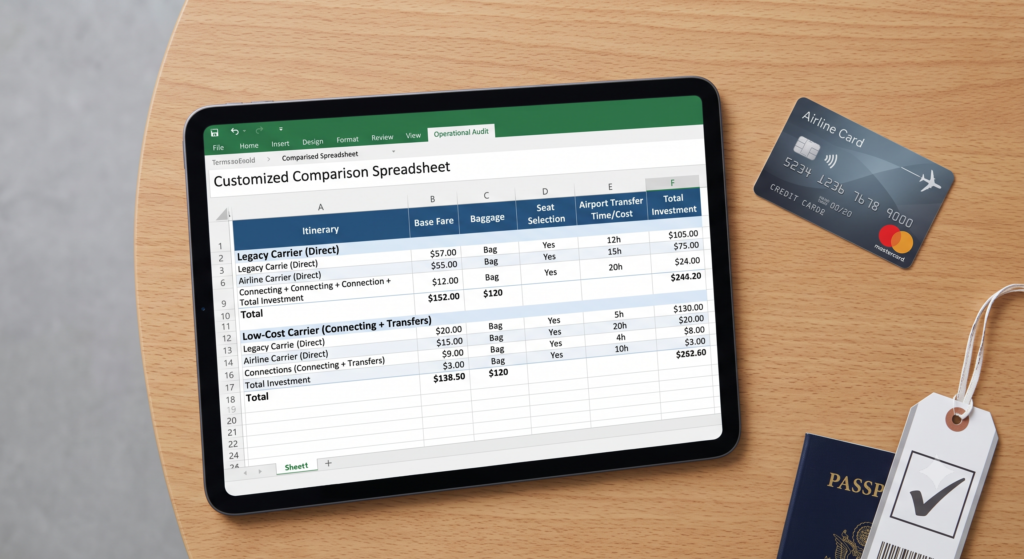
Always calculate your total journey investment, factoring in mandatory baggage fees and ground transit times, before assuming a low base fare is the best deal.
If a low-cost carrier offers a heavily discounted flight to a regional airport, look more closely at the operational reality. Once you add a mandatory cabin bag fee, pay an inflated rate for an express train upon arrival, and subsequently book a coach transfer to reach the city centre, the apparent saving evaporates. You have frequently spent more than the cost of a standard ticket and wasted five hours in transit.
Before choosing the cheapest ticket, ask one final question: what will this journey actually cost in time, convenience, flexibility, and unavoidable extras? The lowest airfare often wins the search results, but the best overall itinerary is frequently the one that delivers the greatest value once the entire journey is taken into account.
Regional Booking Considerations
While the underlying economics of dynamic pricing remain consistent globally, travellers based in different geographic markets encounter unique booking challenges. The overall journey cost must always dictate your decision, but acknowledging regional nuances can help refine your strategy.
If You’re Booking from India
The Indian aviation market frequently features regional booking promotions, digital payment incentives (UPI promotions, credit card offers, festival sales), and carrier-specific seasonal sales. While these can present temporary opportunities to secure a lower airfare, they should never obscure the total transit cost. A promotional fare that requires an inconvenient departure time, severely restricts baggage, or involves flights through a distant airport often ends up costing more in ground transit and sheer exhaustion. Maintain a focus on flight timings, airport convenience, and overall travel value rather than adjusting your itinerary purely to capture a payment promotion.
If You’re Booking from the United States or Canada
Travellers based in North America operate in an environment heavily incentivised by airline loyalty programmes (transferable points) and travel rewards. The abundance of co-branded options means everyday spending can frequently offset long-haul airfares. However, rewards should complement your booking decisions, not dictate them. Selecting a vastly inferior itinerary or a long layover to remain loyal to a specific alliance or to accrue points is an expensive compromise. Itinerary quality, direct routing, and total journey convenience should always take precedence over earning additional miles.
If You’re Booking from Australia
Australia’s unique geography, characterised by vast domestic distances and strong seasonal travel patterns, creates a distinct booking environment. For domestic flights, limited airline competition prevents the aggressive price wars seen in other global markets. Consequently, relying on last-minute discounts is a particularly high-risk strategy. Monitoring fares early and securing a reasonable baseline price is consistently more effective than waiting for a dramatic fare drop that rarely materialises. As always, the overall journey value matters significantly more than the advertised base fare alone.
Common Cheap Flights Myths
The internet is flooded with outdated travel advice that actively damages your ability to secure a good fare. Here is the unvarnished reality of modern airline pricing.
Myth 1: Incognito Mode Lowers Prices. This remains one of the most persistent myths in travel. Airlines do not raise fares simply because you searched for the same flight multiple times. When prices change after refreshing a search, it is usually because seat availability or fare inventory changed while you were browsing, or because the booking platform refreshed previously cached pricing with newer data from the airline. Browsing in incognito mode does not influence how airlines price tickets; it simply prevents your browser from using your normal session information.
Myth 2: Tuesday is Always the Cheapest Day to Book. In the early 2000s, airline executives manually loaded new fare sales into their legacy reservation systems on Monday evenings, meaning the best deals appeared on Tuesday mornings. This manual process has been dead for over a decade. Today, revenue management systems constantly monitor supply, competitor pricing, and global search volume. Fares drop when the system detects a need to stimulate sales, regardless of the day of the week.
Myth 3: Budget Airlines Are Always the Cheapest Option. Ultra-low-cost carriers operate on an unbundled pricing model. They sell you a seat and absolutely nothing else. If you require a wheeled cabin bag, a checked suitcase, or wish to sit next to your travel partner, the cumulative ancillary fees often push the final cost above that of a standard economy ticket on a legacy carrier.
Myth 4: Last-Minute Flights Are Always Discounted. Unless you are booking a package holiday charter flight to a beach destination, waiting until the last minute is an expensive strategy. Scheduled airlines deliberately hold back a small number of seats and price those remaining seats at a premium in the final 72 hours, targeting travellers facing emergencies who possess minimal price sensitivity.
Myth 5: Booking flights in another country’s currency is always cheaper. Sometimes, but rarely. Exchange rates, foreign transaction fees, regional fare rules, and airline pricing policies often eliminate any apparent savings. Compare the final amount charged to your payment method before assuming another currency offers better value.
Frequently Asked Questions
When is the best time to book airline tickets?
The optimal booking window is generally one to three months in advance for domestic flights, two to six months for international flights. Booking nearly a year in advance often results in overpaying, as airlines initially set many fares at a premium before meaningful booking patterns begin to emerge.
How far in advance should I book?
Avoid the temptation to book the moment flights are released. Set price tracking alerts and wait for the airline to begin dynamically managing its inventory. The exception is peak holiday travel, where booking as early as possible is mandatory.
Do flight prices really go down on Tuesdays?
No. This is a relic of the early internet era when fares were manually updated. Today, prices fluctuate constantly based on automated revenue management systems.
Why do flight prices change so quickly?
Airlines use dynamic pricing that adjusts in real time based on fluctuating demand, competitor pricing, and remaining seat inventory. If a price jumps rapidly, it typically means a cheaper fare tier just sold out globally.
Are budget airlines actually cheaper?
Only if you travel strictly within their rigid parameters, if you do not select a seat, do not carry a wheeled cabin bag, and do not require checked luggage, flights are significantly cheaper. Once you add those amenities back in, the final cost often rivals legacy carriers.
Should I book directly with the airline?
Generally, yes. While Online Travel Agencies (OTAs) might offer a small discount, booking directly ensures the airline retains total legal and operational responsibility for your journey. If a flight is cancelled, you will be rebooked immediately rather than being forced to negotiate with a third-party call centre.
What should I avoid when booking flights?
Avoid rigid dates, self-transfers on separate tickets unless you understand the operational risks, ignoring secondary airports, and failing to calculate the true cost of baggage fees before committing to a purchase.
TravelPep’s Cut: Before You Click “Book”
Before you lock in that non-refundable fare, run your itinerary through these final logistical checks:
- Audit the total transit cost: Add the base fare, mandatory baggage fees, and the cost of ground transport at both ends. If the lower airfare forces a premium midnight taxi ride, discard it.
- Set the tracker, ignore the noise: Use Google Flights to automate price alerts two to six months out. Buy when the fare reaches the maximum price you are willing to pay.
- Shift by 48 hours: Check the fare calendar. Moving a Friday departure to a Wednesday is the fastest way to avoid peak algorithmic pricing.
- Expect to pay for extras: You are no longer buying a flight; you are buying a seat. Almost every additional comfort now sits outside the advertised fare.
- Value your time and energy: An eight-hour layover to save a nominal amount is a poor trade-off. Your holiday time and physical energy possess actual monetary value.
Finding cheaper flights has become less about discovering hidden tricks and more about making informed decisions. Travellers who understand how pricing works, remain flexible with dates and airports, and compare the total cost of the journey consistently put themselves in a stronger position than those chasing outdated booking myths. In modern travel, preparation is still the most reliable way to save money.
15 Best Things to Do on Your Honeymoon: Experiences Worth Making Time For